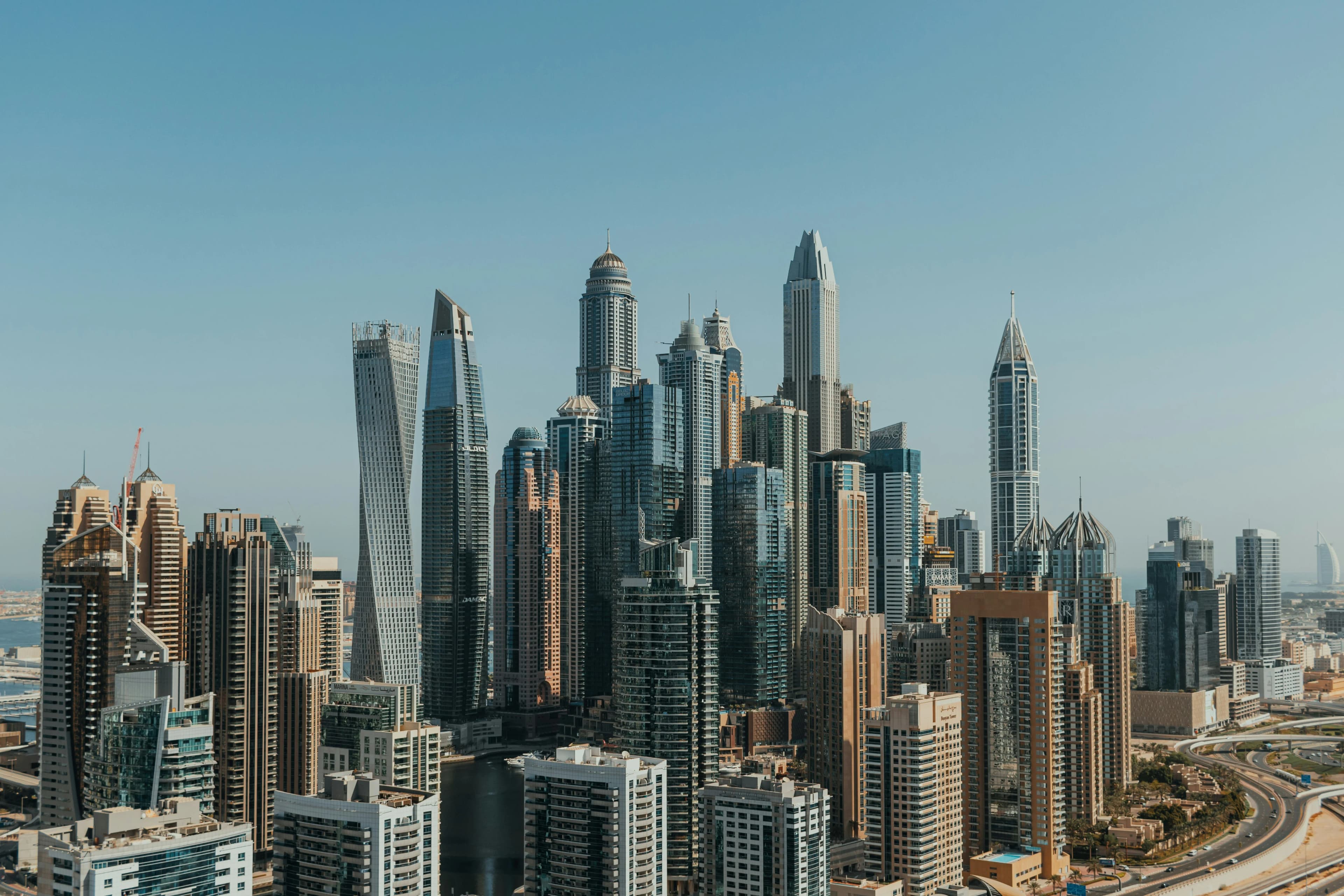
Dubai Marina as a base for suite travelers
For travelers selecting a luxury hotel suite in Dubai Marina, the primary draw is architectural context. Suites positioned on upper floors of the district's hotels offer dual exposures: the marina channel and its moored vessels on one side, the Arabian Gulf and Palm Jumeirah on the other. This duality, water on both horizons, is particular to this neighborhood and shapes the sensory quality of a stay here in ways that inland districts cannot replicate.
How Dubai Marina compares to other Dubai neighborhoods for suite stays
The Dubai hotel landscape is segmented by district in ways that matter to the deliberate traveler. Downtown Dubai concentrates around the Burj Khalifa and the Dubai Mall, offering proximity to cultural institutions and the city's most recognisable skyline. The Palm Jumeirah extends into the Gulf on its own artificial peninsula, with a resort logic that prioritises private beach access and seclusion. Dubai Marina occupies a different register: it is urban and connected, yet waterfront and visually distinct.
Travelers who value walkability alongside luxury will find Dubai Marina more functional than Palm Jumeirah. The Marina Walk and the adjacent JBR (Jumeirah Beach Residence) promenade are accessible on foot, and the Dubai Metro's Red Line connects the district to the broader city. For those staying in a luxury hotel suite in this neighborhood, the combination of pedestrian access and Gulf-facing towers creates a specific kind of urban resort experience that is genuinely rare in the region. For context on the wider country, see the full selection of suites in the United Arab Emirates.
When to plan a luxury suite stay in Dubai Marina
The United Arab Emirates operates on a clear seasonal logic. The period between October and April offers the most comfortable outdoor conditions, with daytime temperatures typically ranging from 20 to 30 degrees Celsius. This is when the Marina Walk and the beach at JBR are fully operational as social and leisure spaces, and when the city's major hospitality events and retail festivals, including the Dubai Shopping Festival which usually runs from December to January, concentrate visitor activity.
The summer months from June to September bring extreme heat, with temperatures regularly exceeding 40 degrees Celsius. Hotels in Dubai Marina respond with aggressive rate reductions and upgraded inclusions during this period, which creates a specific value proposition for travelers who prioritise suite size and amenity access over outdoor exploration. Rooftop pools, spa facilities, and climate-controlled retail spaces become the primary focus of a summer stay.
Ramadan, which shifts annually through the Islamic calendar, alters the operational rhythm of the district. Dining hours change, alcohol service is restricted to licensed hotel venues, and public behaviour norms tighten. Travelers who understand this context find that Ramadan also brings a particular quietness to the city that can make a suite stay feel more private and considered.
Local hospitality standards and what to expect from top-tier suites
The UAE does not operate under a formal palace hotel classification in the way that France designates its Palace label through an official committee. Instead, prestige in Dubai's hotel market is communicated through star ratings, brand affiliation, and the specific language of ultra-luxury positioning that individual properties adopt. The Dubai Department of Economy and Tourism administers a hotel classification system, and five-star properties in Dubai Marina represent the operational and design ceiling of what the market offers.
Within that five-star category, the differentiation between a standard room and a genuine luxury suite is significant. The most considered suites in Dubai Marina will typically offer private terrace access with Gulf or marina views, butler service with dedicated response protocols, separate living and sleeping zones sized generously by international standards, and in some cases, private plunge pools or dedicated jacuzzi installations. The city's hospitality infrastructure is relatively young by European standards, which means that technology integration, connectivity, and contemporary design language are consistently prioritised.
Architectural character of suites in the district
Dubai Marina's hotel stock is almost entirely contemporary in construction. Unlike destinations where historic buildings have been converted into luxury properties, the suites available here exist within towers that were purpose-designed for the hospitality market, typically from the 2000s onward. Floor-to-ceiling glazing is standard. The relationship between interior and exterior view is treated as a primary design consideration. Travelers with a preference for modernist, glass-and-steel environments will find the district's hotel architecture consistent with that sensory expectation.
How to choose the right luxury suite in Dubai Marina
The key variables when selecting a luxury hotel suite in this neighborhood are orientation, floor level, and adjacency to the marina channel versus the open Gulf. Suites facing the marina offer a more urban, contained visual field: the channel, the boats, the opposite towers. Suites facing west toward Jumeirah Beach Residence and the Gulf offer sunset exposure and a more expansive horizon. Neither orientation is categorically superior; the choice depends on whether the traveler is drawn to the city's constructed geometry or to the open water.
Floor level matters considerably in a district of tall towers. Entry-level suites may sit well below the rooflines of neighbouring buildings, limiting the view that defines the luxury proposition here. Suites on upper floors, typically above the 30th level in taller properties, achieve the unobstructed sightlines that justify the premium. Requesting specific floor information before confirming a booking is practical advice for any suite traveler in this district.
Adjacency to the Marina Walk or to the JBR beach is another meaningful variable. Properties closer to the beach end of the district allow for direct pedestrian access to the Gulf without requiring a vehicle. Those positioned deeper within the marina are more embedded in the yachting and restaurant atmosphere of the channel itself.
The value of a curated selection in Dubai Marina
Dubai Marina contains a significant number of hotel properties across varying quality tiers. The concentration of towers in the district means that the gap between a genuinely exceptional luxury suite and a competent but undifferentiated five-star room can be difficult to assess from standard booking interfaces. Photography and listed amenities do not always communicate what matters most: the precision of service, the quality of materials, the actual view from the specific suite category being considered.
La Suite applies a curation logic that filters for properties where the suite experience is a primary design intention rather than a secondary offering within a larger room inventory. For travelers exploring the wider Middle East, the same curation framework extends across the region, allowing a single planning process to cover multiple destinations without compromising on the standards applied at each stop. The curated selection by La Suite reflects the criteria that matter to travelers who book suites deliberately: space, position, service design, and the architectural specificity of the stay itself.