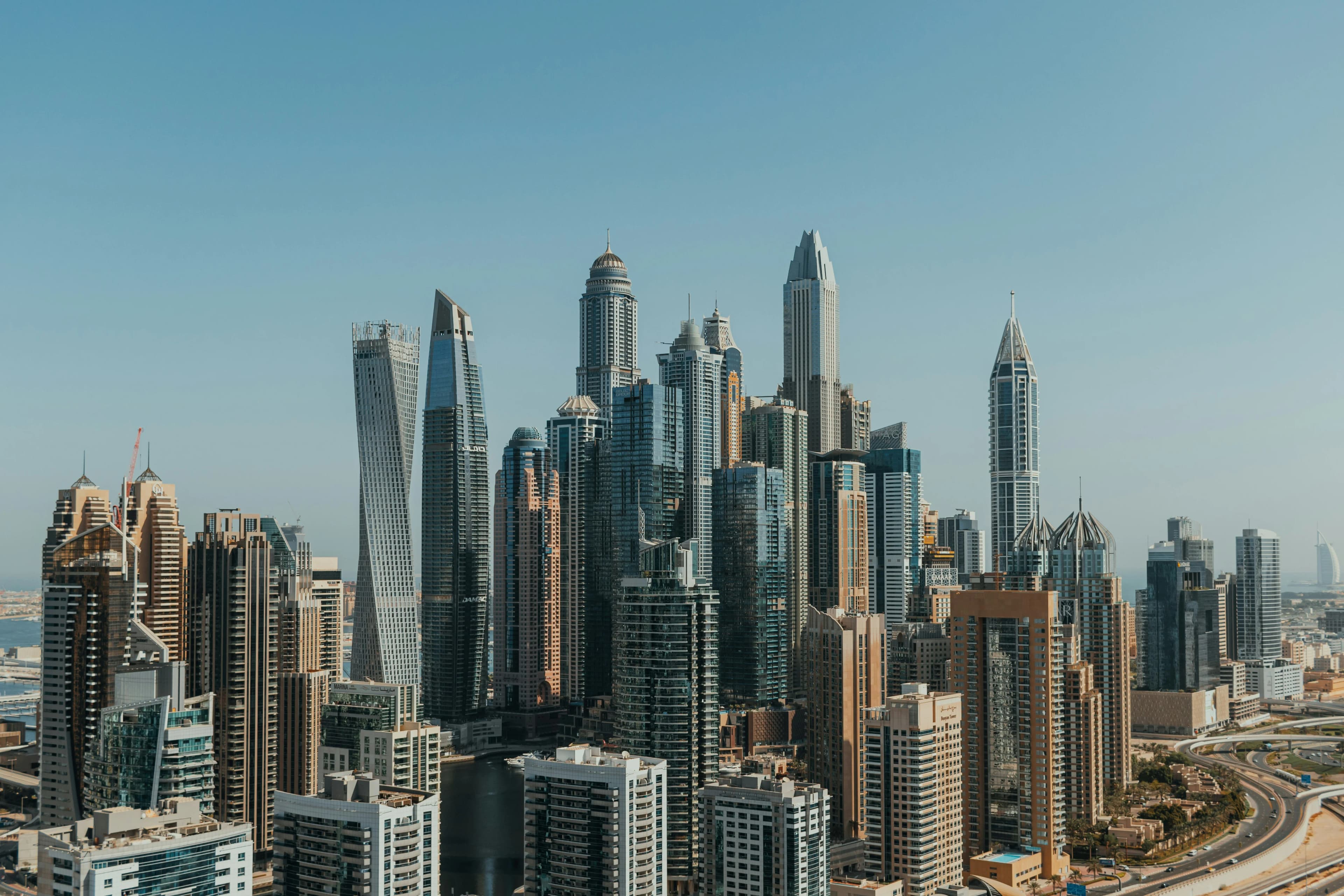
Understanding Palm Jumeirah as a luxury destination
For the high-end traveler, this means that a luxury hotel suite on Palm Jumeirah is almost always a suite with a direct or near-direct relationship to water. The fronds are narrow enough that most properties on them offer Arabian Gulf views from multiple elevations. The crescent, which forms the outer arc of the palm, hosts the largest resort footprints, where suites frequently occupy upper floors of towers with panoramic sightlines across the Gulf toward the Dubai skyline.
Areas within Palm Jumeirah: where to situate yourself
The crescent
The crescent is the outer protective barrier of the palm structure and the address with the greatest concentration of large-format resort hotels. Properties here are defined by scale: expansive grounds, private beach stretches measured in hundreds of metres, and suites designed for guests who want distance from the urban density of the mainland. The views from the crescent face both inward toward the trunk and outward across open Gulf water, offering a sense of genuine coastal isolation despite proximity to the city.
The fronds
The sixteen fronds that extend from the trunk are predominantly residential, but several carry hotel properties that offer a more contained, quieter character than the crescent. Suites on the fronds tend to be integrated into smaller-footprint buildings, often with direct beach access from lower floors and a more intimate scale. The trade-off is a reduced range of on-site amenities compared to the larger crescent resorts.
The trunk
The trunk connects Palm Jumeirah to the mainland via the Palm Monorail and a road tunnel. It carries the island's retail and dining infrastructure, including the Nakheel Mall and a marina. Hotel properties on the trunk are closer to the commercial spine and offer practical convenience, though they trade the immediate coastal immersion of the fronds and crescent for easier connectivity with Dubai's broader urban grid.
When to visit Palm Jumeirah
Dubai's climate divides clearly into two periods. Between October and April, temperatures range from approximately 18 to 30 degrees Celsius, making outdoor activity and beach use comfortable throughout the day. This is when Palm Jumeirah operates at its highest hospitality register: pool decks and private beach sections are functional at all hours, and the Gulf water temperature sits in a range suitable for swimming without thermal discomfort.
From May through September, daytime temperatures regularly exceed 40 degrees Celsius, and humidity rises significantly. Travel during this period is viable for guests who prioritize interior comfort, as suites and hotel facilities are climate-controlled to an exact standard, and rates tend to be considerably lower. The period from November through February is generally considered peak season, coinciding with major events in Dubai including the Dubai International Film Festival and the Dubai Shopping Festival, both of which draw international visitors and affect suite availability at short notice.
Ramadan, which shifts annually according to the Islamic calendar, brings a distinct atmosphere to the city. Many hotel restaurants adjust their service hours, and public consumption of food and drink during daylight hours follows local regulations. For guests staying in a luxury suite, the practical impact is manageable, and the cultural texture of the period has its own considered interest.
Local luxury standards: what to expect from top-tier suites here
The Middle East luxury hospitality market does not operate on the same classification framework as Europe. There is no direct equivalent to the French Palace designation or the Italian Grand Tourism system. In Dubai, the quality signal is primarily carried by the hotel brand itself, by the physical specifications of the property, and by the ratio of staff to guests.
At the top of the market on Palm Jumeirah, a luxury hotel suite will typically offer a floor area above 80 square metres, a private terrace or balcony with Gulf views, dedicated butler service, and access to a private beach section. Many suites at the highest tier include a private pool or plunge pool, a separate living area, and a bathroom with both a soaking tub and a rainfall shower. The finishing materials across these properties tend toward marble, dark hardwood, and custom millwork, with technology integration covering room controls, lighting, and entertainment systems.
Service ratios at the leading properties on Palm Jumeirah are among the highest in the world by hotel industry standards, a reflection of Dubai's positioning as a city where service delivery is a primary competitive variable. Guests should expect proactive rather than reactive hospitality: preferences logged from arrival, dietary requirements pre-empted, and suite configuration adjusted before check-in based on guest profile data.
How to choose the right suite in Palm Jumeirah
The principal choice is between crescent and frond positioning. Guests traveling for a resort experience, with beach and pool use as the primary activity, will generally find the crescent more appropriate. Guests seeking a quieter, more residential character with direct water access at a smaller scale should consider frond-facing properties.
Floor level is a meaningful variable here. The Gulf is flat, and views from upper-floor suites on the crescent extend across both the water and the Dubai skyline simultaneously, a combination that justifies the premium on elevation. Mid-floor suites offer closer proximity to beach-level facilities and a different spatial relationship with the landscape.
For guests combining a Palm Jumeirah stay with time elsewhere in Dubai, connectivity from the island to the mainland is efficient via the monorail to the Dubai Metro or by road, but journey times into the central business districts of DIFC or Downtown Dubai typically run between twenty and forty minutes depending on traffic.
The value of curation on Palm Jumeirah
Palm Jumeirah hosts a concentrated number of internationally recognized hotel brands, all operating within a narrow geographic area. The surface-level similarity between properties makes independent comparison time-intensive and often misleading: marketing materials for suites in this category are uniformly polished, and the differentiating details, suite orientation, staff-to-guest ratios, beach quality, construction year, and renovation history, are not consistently surfaced in standard booking channels.
La Suite approaches this selection with the same editorial discipline applied across all destinations in the Middle East portfolio. The curated selection identifies which properties deliver on the specific promises that matter to guests choosing a luxury suite: genuine privacy, spatial quality, service consistency, and a physical relationship with the Gulf that justifies the address. The result is a filtered view of Palm Jumeirah that removes the noise and focuses on the properties that perform at the level the destination's reputation implies.