Where to stay in Banff for a luxury suite experience
The upper corridor along Banff Avenue and the properties elevated above the townsite command the most direct mountain sightlines. Suites in these locations are oriented toward panoramic views of the surrounding peaks and the Bow Valley, giving guests a spatial relationship with the landscape that is architectural rather than incidental. Properties here tend to favor natural materials: stone, timber, and steel that echo the geology underfoot.
For those seeking greater seclusion, the Fairmont Banff Springs area and the slopes toward Tunnel Mountain offer a degree of separation from the town's pedestrian activity. This is where the tradition of grand mountain hospitality is most legible, with properties that have been part of the Canadian Rockies narrative for well over a century. The suite experience in these locations carries a historical register alongside its physical comfort.
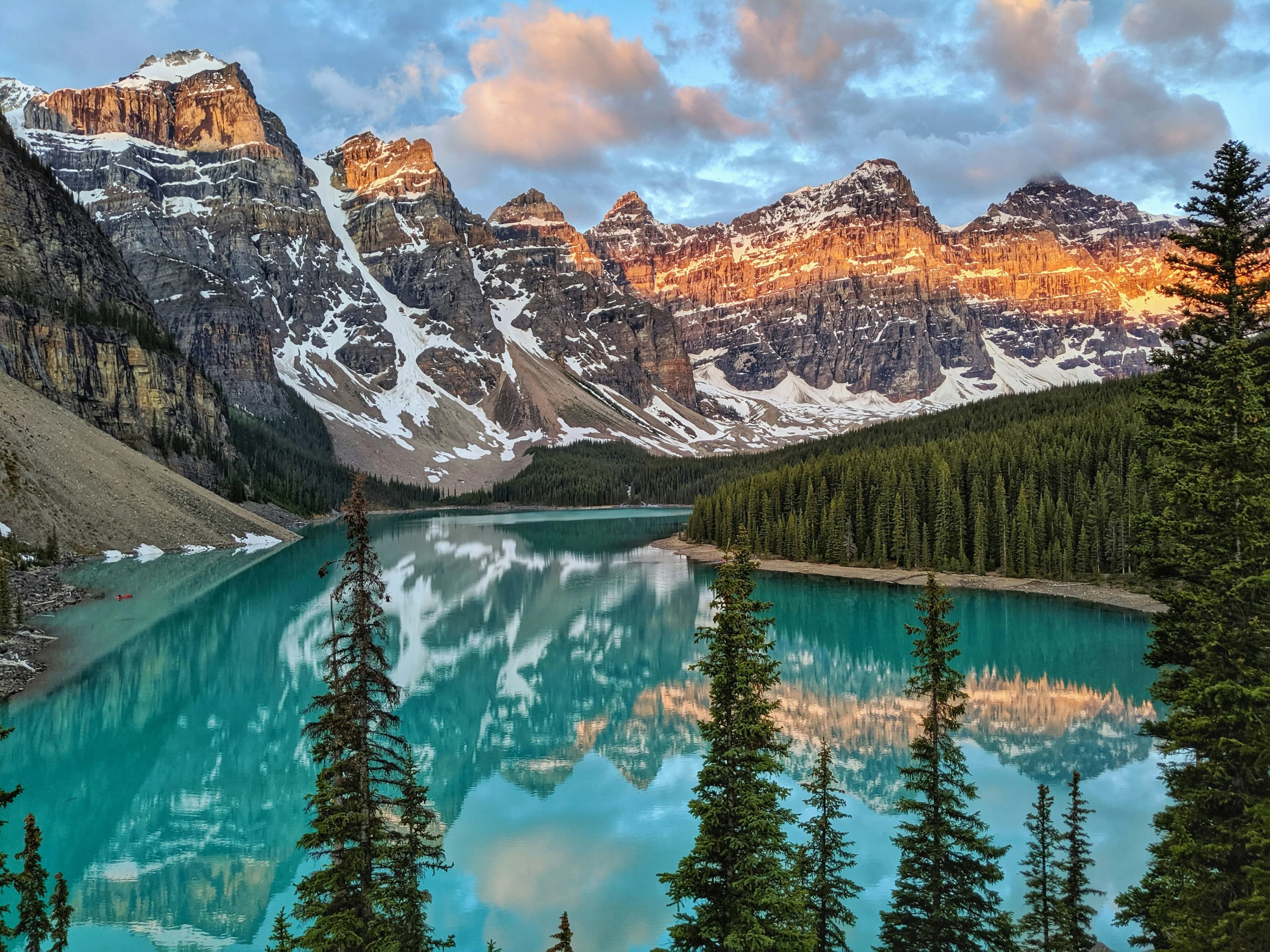
Lake Louise, located approximately 60 kilometers northwest of Banff, functions as a separate epicenter of alpine luxury. The lake itself, fed by glacial meltwater and framed by Victoria Glacier, defines the visual identity of the area. Properties here are limited in number and high in demand, making early reservation essential. Suites with direct lake orientation are among the most sought-after in the Canadian Rockies.
When to visit Banff for a suite stay
Banff operates as a genuine four-season destination, and the optimal window depends on what kind of experience the traveler is seeking.
Winter, from December through March, is the period of highest visual drama. The snowpack is consistent, the frozen surface of Lake Louise takes on a translucent blue-green quality, and the skiing at Banff Sunshine, Lake Louise Ski Resort, and Mount Norquay provides structured activity at a high standard. Suite demand peaks during the holiday period and over February's Ice Magic festival at Lake Louise, when internationally recognized ice sculptors work on the lake's edge. Availability narrows significantly during these windows, and pricing reflects that compression.
Late spring, from May into June, is a transitional period. Snow lingers at higher elevations, trails are opening progressively, and hotel rates offer relative value compared to peak periods. The light during these weeks is particularly photographic, with snow-covered peaks contrasting against the first green of lower valleys.
Summer, from late June through August, is the highest-traffic season. The park receives the majority of its annual visitors during these months, and Banff Avenue can feel congested at midday. For suite travelers, this period still offers the fullest access to hiking, kayaking, and wildlife observation, with the longest days and warmest temperatures. Properties with private terraces or elevated positions provide natural separation from the town's busiest moments.
September and early October represent what many experienced travelers consider the ideal balance. Crowds diminish, aspen and larch trees turn gold across the valley floors and mountain slopes, and temperatures remain comfortable for outdoor activity. The larch season in particular, centered on trails around the Larch Valley near Lake Louise, draws those with an eye for landscape.
Understanding luxury standards in Banff
Canada does not apply a formal palace designation in the manner of France, but Banff has its own vernacular of prestige. The Historic Hotels of Canada designation applies to certain properties that combine architectural heritage with continued operational excellence, and this recognition carries weight in the market.
The dominant aesthetic in Banff's top-tier properties is what might be described as mountain modernism: the integration of local stone and old-growth timber framing with contemporary thermal comfort, high-specification glazing, and spatial generosity. A well-executed luxury suite in Banff typically includes floor-to-ceiling windows calibrated to the specific mountain orientation, oversized soaking tubs positioned to capture those views, and materials selected for tactile as well as visual coherence.
Fireplaces, whether gas or wood-burning, are a standard feature in the upper suite categories and function as an architectural element rather than an amenity footnote. The inclusion of a fireplace in a suite at this latitude signals a considered approach to the seasonal experience.
Service standards in Banff's leading properties align with international luxury expectations. Concierge teams at this level typically have established relationships with park guides, heli-skiing operators, private wildlife trackers, and fine dining reservations. The proximity to Banff National Park means that well-connected properties can facilitate experiences that are not accessible through public channels alone.
How to choose the right luxury suite in Banff
Several practical considerations apply specifically to Banff that differ from urban luxury hotel selection.
View orientation is a primary variable. Not all mountain views are equivalent. A suite facing south toward Sulphur Mountain offers a different quality of light than one oriented west toward the Bow Valley at sunset. Travelers with a preference for morning light should request east-facing configurations. This is worth specifying at the time of reservation rather than treating as incidental.
Floor level matters in a different way than in an urban tower. In Banff's low-rise property landscape, the difference of one or two floors can determine whether the treeline obscures the mountain mid-section or whether the view is uninterrupted. Properties with rooftop or penthouse suite configurations offer the clearest sightlines.
The question of historical versus contemporary architecture is also relevant. Banff has both grand legacy properties, constructed in the castle style during the Canadian Pacific Railway era, and newer builds with a minimalist alpine sensibility. These offer genuinely different spatial and aesthetic experiences. Travelers who value architectural narrative may favor the former; those who prioritize clean lines and a more restrained material palette may prefer the latter.
Proximity to the national park trails, rather than proximity to Banff Avenue retail, is a more useful spatial metric for most suite travelers in this environment. Properties within walking distance of Bow Falls, the Hoodoos trail, or the gondola base stations position guests to use the landscape as an extension of the suite itself.
Why curated selection matters in Banff
The luxury accommodation market in Banff is narrower in volume than comparably positioned destinations, but variation in quality is considerable. The designation of a room as a suite does not guarantee the spatial or experiential standards that the category implies. La Suite applies consistent criteria across every property in its selection: verified suite dimensions, view quality, service infrastructure, and the capacity of the property to support the kind of privacy and discretion that discerning travelers require.
In a destination where availability is structurally limited and demand is predictable across multiple seasons, accessing a curated selection early in the planning process is a practical advantage. The curated selection by La Suite reflects properties where the suite experience in Banff is executed with the coherence and care that justifies the investment.