Understanding Mont-Tremblant as a luxury destination
The architectural register here is distinct. Properties draw from Quebec's French colonial building tradition, with steeply pitched rooflines, stone facades, and interiors that balance a Nordic sensibility with specific references to the province's own craft and material culture. This is not the generic alpine aesthetic found across North American ski towns. There is a local character to Mont-Tremblant that rewards travelers who engage with it deliberately.
Areas of Mont-Tremblant worth knowing before you book
The pedestrian village and ski-in, ski-out corridor
The village at the base of the mountain is the most concentrated zone of hospitality. Properties here offer immediate access to ski lifts in winter and to the event calendar, restaurant circuit, and lakeside amenities in other seasons. For travelers whose priority is proximity to activity, this corridor makes practical sense. Suites in this zone tend toward a compact resort format, with higher density and a lively street-level atmosphere.
Lac Tremblant and the surrounding lakefront
The lakefront zone offers a different register entirely. Properties positioned along Lac Tremblant or in the broader Laurentian lake district prioritize privacy, water access, and spatial generosity. This is where suites tend to be larger, more architecturally considered, and more oriented toward stillness. For travelers arriving in summer or autumn, this geography often produces the more compelling stay.
The surrounding Laurentides region
Beyond the immediate resort perimeter, the Laurentides region offers a more dispersed landscape of smaller properties, private chalets, and boutique hotels that cater to travelers seeking distance from the resort energy. This terrain is better suited to extended stays, wellness-focused visits, or travelers who want Mont-Tremblant as a base rather than a destination in itself.
When to visit Mont-Tremblant for a suite stay
Mont-Tremblant operates on a genuine four-season model, and the calculus for suite availability shifts accordingly.
Winter, from December through March, represents peak demand. The Tremblant resort receives an average annual snowfall of approximately 450 centimetres, and the ski season draws the highest concentration of domestic and international visitors. Suite availability during this period is tightest, and rates reflect it. Booking well in advance, typically three to six months for premium inventory, is not optional during ski season weekends and holiday periods.
Summer, from late June through August, has grown significantly as a travel period. Golf on the resort's courses, water sports on Lac Tremblant, trail access in the Parc national du Mont-Tremblant, and the outdoor concert series bring a different but equally committed traveler. Suite rates in summer are generally more accessible than in peak winter, and the light quality and landscape character offer their own strong case.
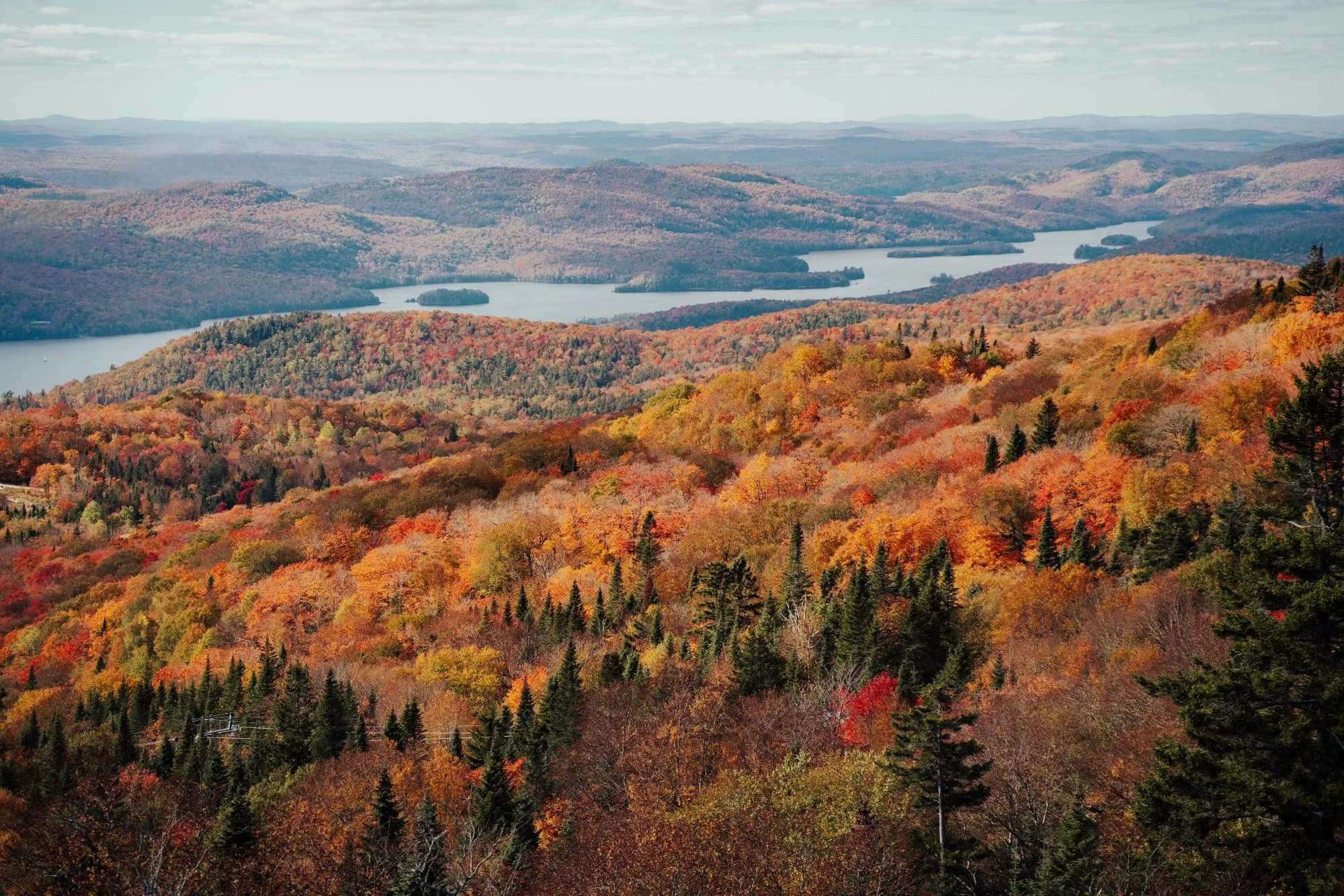
Autumn, September through mid-October, is increasingly regarded as the most atmospheric season. Quebec's boreal forest produces a foliage sequence of particular intensity, and the combination of cool temperatures, low crowds, and visual drama makes this period genuinely distinctive. Spa-focused properties and lakefront suites perform especially well in this window.
Spring, April through May, is the quietest period and offers the most flexibility for last-minute suite bookings at reduced rates. It is a transitional season without a strong identity, but it works for travelers whose schedule does not permit peak-season travel.
Local luxury standards in Quebec resort hospitality
Canada does not operate the same formal hotel classification system found in France or certain European markets. There is no equivalent to the French Palace designation. Quebec's own tourism authority uses a star classification system, but the upper tier of hospitality in Mont-Tremblant is better understood through the lens of resort branding and operator identity than through formal accreditation.
What distinguishes the top tier of Mont-Tremblant hospitality is typically a combination of suite square footage, the presence of private terrace or balcony access with mountain or lake orientation, dedicated concierge architecture, and integration with spa and wellness infrastructure. The best properties here treat the suite as a spatial experience connected to the landscape, not simply a larger hotel room with upgraded linens.
Quebec's hospitality culture also carries a specific linguistic and culinary identity. French is the province's official language, and the cultural texture of service, cuisine, and design in Mont-Tremblant reflects this. The food culture leans toward a Quebec interpretation of French technique, with strong local sourcing from the Laurentides agricultural zone. Travelers who engage with this cultural specificity rather than expecting a generic North American resort experience tend to find Mont-Tremblant considerably more rewarding.
How to choose the right suite in Mont-Tremblant
The primary decision axis in Mont-Tremblant is proximity versus privacy. Village-adjacent suites maximize access and energy; lakefront or forest-edge suites maximize space and silence. Neither is inherently superior, but they serve fundamentally different travel intentions.
Architecture is a secondary but meaningful consideration. Some properties in Mont-Tremblant have been built to evoke the heritage Quebec townscape, with traditional materials and a warm interior palette. Others have adopted a more contemporary mountain aesthetic, with floor-to-ceiling glazing, raw concrete, and a palette derived from the forest exterior. Establishing a preference before booking avoids arriving in a space that works against your sensibility.
For winter visits, ski-in, ski-out access is a genuine functional advantage, not just a marketing phrase. The difference between a property on the slope corridor and one requiring a shuttle or vehicle becomes materially relevant across a multi-day ski trip. Conversely, for summer and autumn visits, this attribute is largely irrelevant, and direct lake or forest access becomes the more meaningful criterion.
Spa facilities deserve direct evaluation. Several properties in Mont-Tremblant have invested seriously in thermal and wellness infrastructure, with outdoor hot pools, Nordic circuit programming, and treatment menus calibrated to the seasons. For travelers whose suite stay includes a significant wellness component, the quality and scale of the spa is as important as the room itself.
Why curated selection matters in Mont-Tremblant
Mont-Tremblant's hospitality market is smaller and more concentrated than major urban destinations, but the variance in suite quality within it is significant. The resort model means that some properties prioritize volume and operational scale over the individual suite experience. Others, often smaller or more recently repositioned, have made the suite as the central product rather than an afterthought.
La Suite's curated selection for Mont-Tremblant applies the same editorial framework used across all destinations on the platform: spatial generosity, architectural coherence, service quality, and the degree to which the suite experience connects meaningfully to its specific geography. In a market where brand recognition does not always track with actual suite quality, this kind of independent curation provides a clarity that broad booking platforms cannot offer.