Where to stay in California: distinct territories for suite travel
The coast: Malibu, Big Sur, and the Central Coast
The Pacific Coast Highway corridor between Los Angeles and San Francisco defines a particular kind of California suite experience: horizontal, light-saturated, architecturally deliberate. Properties here tend toward low profiles and large glazed facades oriented toward the ocean. The emphasis is on quietude and visual exposure rather than opulence in the conventional sense. Big Sur, inaccessible by commercial airport and intentionally limited in development density, attracts travelers who treat remoteness as a premium. The Central Coast, including the area around Carmel-by-the-Sea and Santa Barbara, offers a Mediterranean microclimate and a slower cadence suited to multi-night stays.
Napa and Sonoma: wine country suite culture
The Napa Valley and its neighbour Sonoma County have developed a hospitality standard built around the estate experience. Suites in this corridor are frequently integrated into working vineyards or positioned within sight of the Mayacamas or Vaca mountain ranges. The luxury here is agricultural in origin and experiential in execution: private tastings, vineyard-edge terraces, and menus constructed around what grows within a short radius. Sonoma tends toward a less formalised aesthetic than Napa, with more emphasis on farm-to-table informality and open land.
Palm Springs and the desert interior
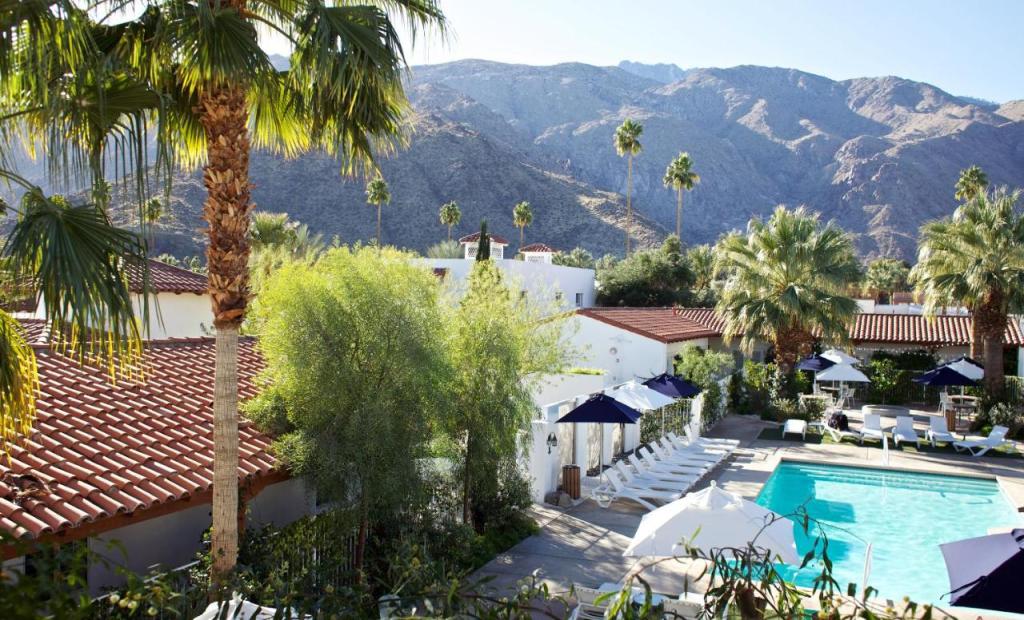
Palm Springs carries a mid-century architectural identity that remains coherent and rigorously maintained. The luxury hotel suite product here is often structured around private pools, shaded outdoor rooms, and the particular silence of the Coachella Valley in the early morning. The desert light, intensely directional and warm, gives even mid-scale properties a visual clarity that more humid climates cannot replicate. The Coachella Valley also hosts some of the most significant cultural and music events in the United States, which affects availability and pricing at peak periods.
Los Angeles and San Francisco: urban suite formats
Both cities offer a different proposition. Los Angeles suites tend toward residential scale, with penthouses and bungalow-format rooms that reflect the city's car-dependent, neighbourhood-based structure. West Hollywood, Beverly Hills, and Malibu each carry distinct social registers. San Francisco's suite market is concentrated in Nob Hill and the Financial District, with a European hotel tradition that differs noticeably from the resort formats dominant elsewhere in the state.
When to visit California for a luxury suite stay
California's climate varies considerably by microregion, which directly affects the logic of when to visit and where to stay.
The coast operates best in late spring and early autumn. Summer months bring a coastal fog phenomenon known locally as June Gloom, which can persist through July along the Los Angeles and San Francisco shorelines. September and October typically deliver the most consistent coastal light and warmest sea temperatures. Wine country peaks in September and October during harvest season, when vineyard activity is highest and events are most concentrated. Suite availability in Napa and Sonoma tightens significantly during this window, and rates reflect the demand.
Palm Springs is a winter destination by design. From November through April, temperatures in the Coachella Valley are reliably warm without the extreme heat that makes summer months inhospitable for outdoor living. The Coachella Valley Music and Arts Festival, held across two weekends in April, generates a specific demand spike that affects pricing throughout the region. Stagecoach Festival follows immediately after. Travelers seeking suite availability during those weekends should plan well in advance, typically six to twelve months.
San Francisco maintains a relatively consistent year-round temperature range, rarely exceeding 20 degrees Celsius. The city suits shoulder-season visits, particularly May and September, when fog is less persistent and cultural programming is active.
Understanding California's luxury hotel standards
California does not operate under a formal prestige classification system equivalent to France's Palace designation. The Forbes Travel Guide star rating and AAA Diamond system are the primary independent benchmarks used by American luxury hospitality. Forbes Five-Star and AAA Five Diamond properties represent the upper tier, and California holds a disproportionately high concentration of both relative to its land area.
The state's top-tier luxury hotel suites are characterised by several consistent features: large footprints (frequently exceeding 90 square metres), dedicated butler or concierge services, private outdoor space, and a design sensibility that references the local architectural tradition rather than an imported European model. Californian luxury hospitality has developed its own vocabulary, one in which indoor-outdoor integration, natural materials, and restrained palette are considered baseline expectations rather than differentiators.
Resort fees are a structural element of California hotel pricing that travelers should account for. These mandatory daily charges, separate from room rates, cover amenity access and services, and can add a material sum to the total cost of a stay. Transparency on this point is a minimum standard that La Suite applies to all listed properties.
How to choose the right luxury suite in California
The first variable is landscape. California's geographic diversity means that the character of a suite experience changes fundamentally depending on whether the property sits on a coastal bluff, within a vineyard estate, or in a desert canyon. Clarifying what kind of physical environment you want to inhabit is the primary filter.
The second variable is architectural character. California has produced distinct periods of residential and hospitality architecture: Spanish Colonial Revival, which is prevalent in Santa Barbara and the Baja-influenced south; mid-century modernism, concentrated in Palm Springs and Los Angeles; and contemporary vernacular, which draws on redwood, stone, and glass in ways specific to Northern California. Each carries a different sensory quality, and the choice between them is not merely aesthetic but also spatial.
Privacy configuration matters in this state more than in most. Given the high volume of high-profile travelers who use California's luxury hotels regularly, suites with private entrances, dedicated pool access, or bungalow formats command a specific premium and are frequently unavailable for short-notice booking. Planning lead time for these categories is typically longer than the general market.
Why a curated selection by La Suite matters in California
California's luxury hotel market is extensive and, at the upper end, not always legible from standard booking platforms. Properties that present well in photography do not always deliver at the suite level. Conversely, some of the most considered suite products in the state are housed in properties with minimal marketing visibility.
La Suite applies a consistent editorial and spatial standard across every listed property. The selection process accounts for suite-specific criteria: room geometry, light quality, outdoor access, privacy architecture, and service configuration. The goal is to reduce the decision cost for travelers who do not have the time or local knowledge to evaluate the California market at this level of resolution. The curated selection by La Suite is designed to function as a direct answer to a specific question: which suite, in which part of California, for this particular kind of stay.