Where to stay in Louisiana: distinct territories for luxury suite travelers
New Orleans and the French Quarter corridor
The French Quarter remains the architectural and cultural nucleus of Louisiana's luxury hotel offer. Buildings here date to the late 18th and 19th centuries, with cast-iron balconies, internal courtyards, and thick masonry walls that create a particular sensory environment: cool interiors, the filtered light of louvred shutters, and the ambient noise of one of America's most acoustically layered urban spaces. Uptown and the Garden District extend that offer into broader residential proportions, with converted mansions and boutique properties set among live oaks and formal gardens. The Warehouse Arts District presents a contrasting typology: repurposed industrial buildings that now house design-forward hotels with a more contemporary suite language.
River Road and plantation country
The corridor along the Mississippi River between New Orleans and Baton Rouge contains a concentration of antebellum plantation houses, a number of which now operate as high-end accommodations. The experience is architecturally specific: wide verandas, raised foundations, formal symmetry, and grounds planted with centuries-old oaks draped in Spanish moss. For travelers whose primary interest is architectural immersion and a slower, more private form of luxury, this corridor offers something the city cannot replicate.
Cajun Country and the Atchafalaya Basin
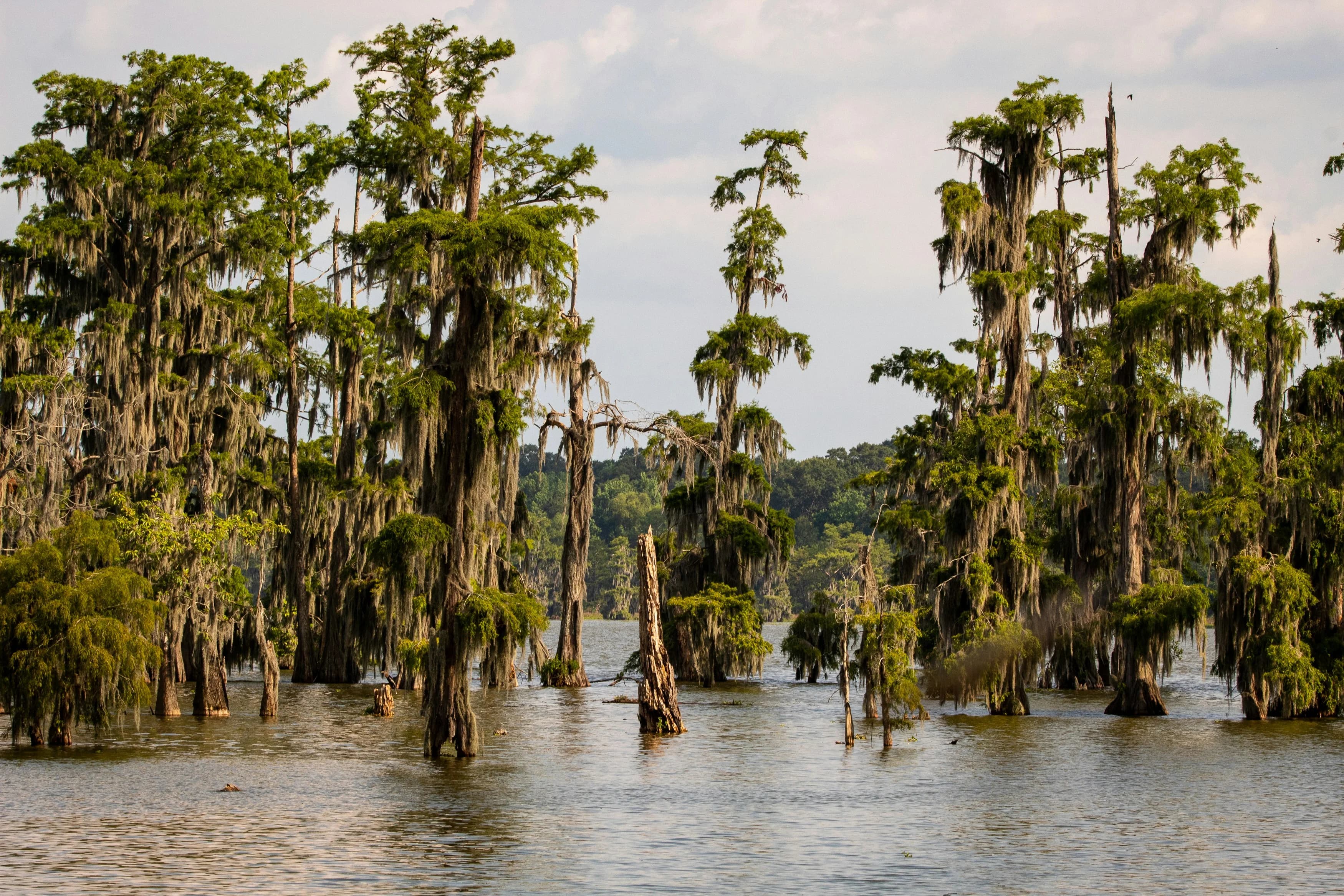
The southwestern parishes, centered loosely around Lafayette and the Atchafalaya Basin, represent Louisiana's least urbanized luxury proposition. The landscape here is defined by cypress swamps, prairie grasslands, and waterways that function as primary routes through the terrain. Suite accommodations in this region tend toward boutique scale, with an emphasis on ecological setting and direct access to the natural environment. The cultural backdrop is Cajun rather than Creole, with its own distinct musical traditions, culinary vocabulary, and social cadence.
The Gulf Coast and Northshore
Louisiana's Gulf Coast, including the communities east and west of New Orleans, and the Northshore area across Lake Pontchartrain, offer waterfront suite options with a less urban character. Properties here tend to be resort-format, oriented toward the water and the particular quality of light that defines the Louisiana coastal environment.
When to visit Louisiana for a luxury suite stay
The question of timing in Louisiana is more consequential than in most American destinations, because the climate and the calendar of cultural events both bear directly on the suite experience.
The period from October through April represents the most comfortable window climatically. Temperatures are moderate, humidity is lower, and the city of New Orleans in particular enters its most concentrated sequence of cultural events. The fall months bring literary and culinary festivals that draw an informed, design-literate audience. The period culminating in Mardi Gras (typically February or early March, depending on the liturgical calendar) is the state's most internationally recognized cultural event. Suite demand across New Orleans reaches its annual peak in the weeks surrounding Mardi Gras, and availability at the most sought-after properties requires planning well in advance, often a year or more for the best suites.
The Jazz and Heritage Festival, held across two weekends in late April and early May, represents a second high-demand window. This event consistently attracts a global audience and places significant pressure on suite inventory in New Orleans and the surrounding area.
Summer in Louisiana is climatically demanding: high temperatures combined with substantial humidity make outdoor activity less comfortable, and the period from June through November carries hurricane risk. That said, summer rates are generally lower, and travelers whose itinerary is primarily interior-focused (culinary, cultural, architectural) often find the off-season proposition favorable.
Louisiana's luxury hospitality standards: what to expect from the top tier
Louisiana does not operate within the French Palace classification system, nor does it have a formal state-level prestige designation equivalent to those found in certain European frameworks. The relevant quality signals are instead a combination of national hotel rating systems, the age and provenance of the property, and the reputation of the culinary and service programs attached to it.
At the upper end of the New Orleans market, the most significant suites are found in historic buildings that have been restored with attention to original fabric: plasterwork, ironwork, wide-plank flooring, and period proportions that no new-build can replicate. The suite experience in these properties is inseparable from the architecture. Space is often generous by urban standards, with ceiling heights that reflect 19th-century construction norms and private outdoor areas (balconies, courtyards, private gardens) that function as an extension of the interior.
Service culture in Louisiana's best hotels carries the influence of the state's hospitality traditions, which are among the most developed in the American South. Food and beverage programs at the top tier are treated with the same seriousness as the rooms themselves. Louisiana's culinary canon, rooted in French technique and modified by Creole, African, and Caribbean influences, means that in-suite dining and restaurant access are genuine differentiators rather than peripheral amenities.
How to choose the best luxury suite in Louisiana
Several considerations are specific to this destination and deserve attention before any selection is made.
First, the distinction between historic and contemporary properties is particularly pronounced in Louisiana. A suite in a French Quarter property from the 1830s will offer a fundamentally different spatial and sensory experience from a suite in a modern design hotel in the Warehouse District. Neither is categorically superior, but they address different travel intentions, and clarity on that distinction is essential.
Second, the question of noise environment matters in New Orleans in a way it does not in most cities. Properties within or immediately adjacent to the French Quarter sit within an acoustically active urban environment that does not follow conventional overnight hours. Travelers seeking quiet should consider properties in the Garden District, Uptown, or on the Northshore. Travelers who want direct access to the street life of the Quarter should weigh that against the acoustic reality.
Third, the presence of a private outdoor space (balcony, courtyard, or garden) is a meaningful differentiator in Louisiana. The climate, for much of the year, supports outdoor use in the morning and evening, and properties that offer this at the suite level provide a qualitatively different experience from those that do not.
Fourth, for plantation country stays, accessibility and privacy are the primary functional considerations. These properties are typically set at distance from urban centers, and the suite experience is largely self-contained. Confirming what is available on-site (dining, grounds access, guided experiences) is more important here than in an urban context.
Why curation matters for Louisiana suite selection
The Louisiana luxury hotel market contains genuine quality across a range of property types, but it also contains a significant number of properties that trade on historical association or atmospheric marketing without delivering suite-level quality in a measurable sense. The gap between a well-curated suite and a merely well-located room is substantial, and that gap is not always legible from standard booking platforms.
La Suite approaches Louisiana with the same editorial discipline applied to every destination in its portfolio. The selection reflects properties where the suite itself, not just the hotel brand, justifies the classification: where the architecture, the spatial quality, the service standard, and the local specificity combine into an experience that is coherent and intentional. For a destination as layered and culturally particular as Louisiana, that discipline is not a luxury. It is a prerequisite.