Where to stay in New Hampshire for a luxury suite experience
The White Mountains region
The White Mountains corridor, anchored by the Mount Washington Valley and the towns of North Conway, Bretton Woods, and Franconia Notch, represents the state's most historically significant luxury territory. Grand resort hotels established here in the late nineteenth century as railway destinations survive in various forms today, offering suites that combine period scale with contemporary amenity. The physical drama of Presidential Range summits above treeline, accessible by cog railway or on foot, gives suites with mountain-facing outlooks an almost cinematic presence during both foliage and winter seasons. This is architecture conceived for landscape contemplation, and the best properties have not forgotten that founding purpose.
The Lakes Region
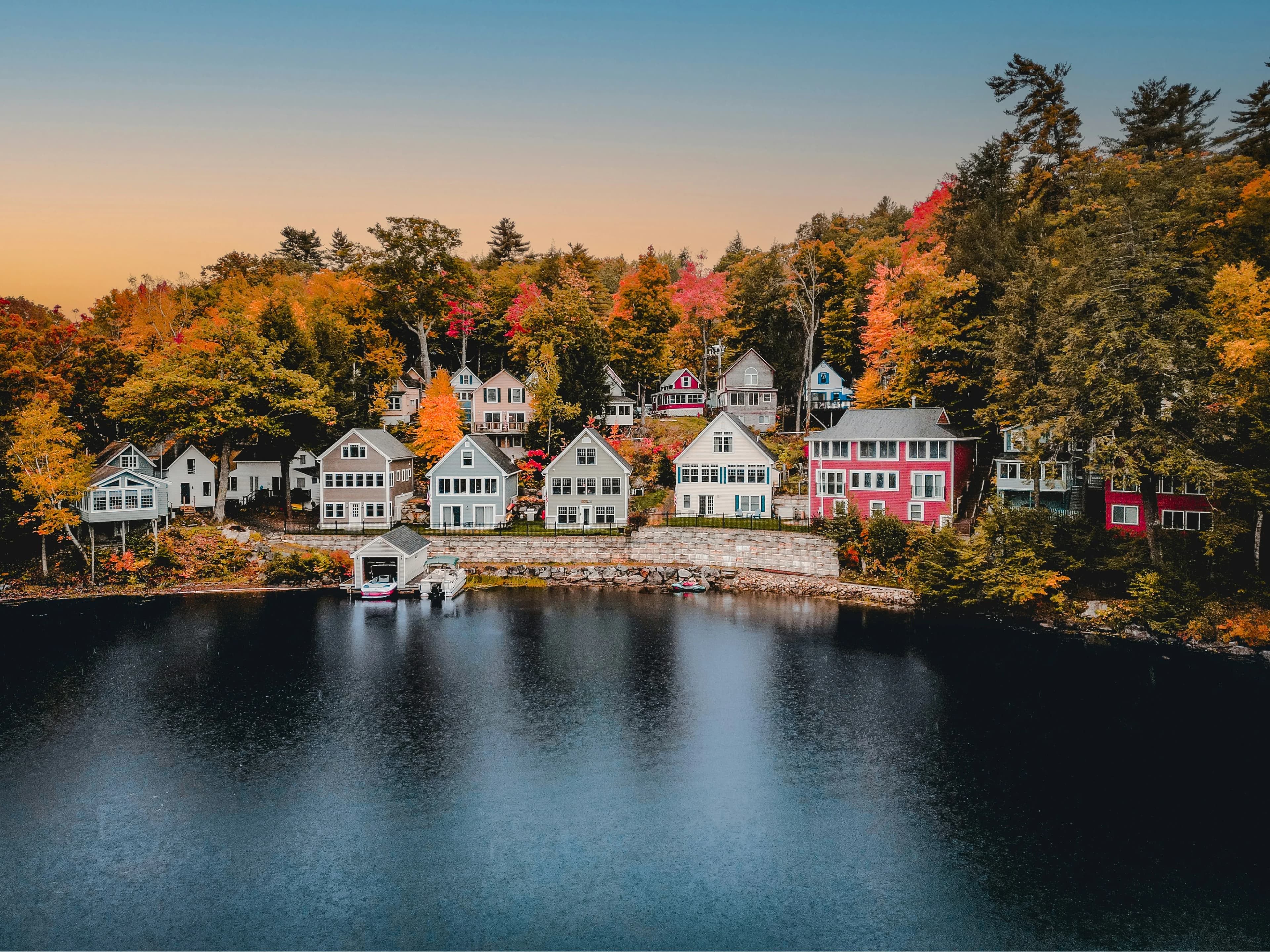
Lake Winnipesaukee and its surrounding water bodies form the geographic and social center of the Lakes Region, a territory that has attracted New England families for generations. Luxury accommodations here tend toward the intimate: restored inn properties and lakeside retreats where the suite experience is defined by water proximity, dock access, and a rhythm calibrated to early mornings on still water. The atmosphere is less theatrical than the White Mountains and more residential in feeling, which suits travelers seeking extended stays or a deliberate deceleration.
The Seacoast and Monadnock regions
New Hampshire's eighteen miles of Atlantic coastline, concentrated around Portsmouth and Hampton Beach, is brief but architecturally rich. Portsmouth in particular functions as a small-scale historic city with a genuinely sophisticated cultural and culinary infrastructure, making it the most urbane base in the state. The Monadnock region in the southwest, centered on Mount Monadnock and the town of Peterborough, offers a more pastoral register favored by those drawn to arts communities, covered bridge landscapes, and farmland views.
When to visit New Hampshire for a luxury hotel stay
New Hampshire is a four-season destination, but each season presents a meaningfully different proposition for the luxury traveler.
Autumn, specifically the period from mid-September through mid-October, is the most sought-after window. The foliage sequence moves from north to south across the state, and suite availability at peak-period properties in the White Mountains tightens considerably. Booking lead times of several months are standard practice for the most desirable properties during this period.
Winter draws skiers and snow-culture travelers to resorts at Bretton Woods, Loon Mountain, and Cannon Mountain. Suite accommodations at ski-adjacent properties offer ski-in and ski-out access or short transfers, and the combination of log-fire interiors and snow-loaded conifer landscapes creates a sensory coherence that is genuinely difficult to replicate elsewhere on the East Coast.
Spring is the state's quietest luxury season, with mud season making parts of the interior less accessible in March and April. Late May brings wildflowers and significantly lower room rates, rewarding travelers with flexibility.
Summer occupies the Lakes Region at its fullest. Water temperatures on Lake Winnipesaukee reach comfortable levels by July, and the long northern daylight hours extend the useful day considerably. Summer is also when the state's outdoor concert series, agricultural fairs, and arts events reach their peak calendar density.
Understanding luxury standards in New Hampshire
New Hampshire does not operate within a formal prestige labeling system comparable to France's Palace designation or Italy's Leading Hotels framework. Quality signaling here is more informal and relies on a combination of AAA Diamond ratings, membership in independent hotel consortia such as Relais and Chateaux or Small Luxury Hotels of the World, and the cumulative weight of editorial reputation.
The state's most distinguished luxury properties tend to fall into two typological categories. The first is the grand resort hotel, a form specific to the White Mountains and rooted in the nineteenth-century tradition of the American resort as destination in itself. These properties are characterized by architectural scale, extensive grounds, multiple dining concepts, and suites that prioritize views and volume. The second category is the refined country inn, a smaller-scale property where the suite experience is defined by individual character, locally sourced materials, and proximity to a specific natural or cultural feature.
Travelers accustomed to urban luxury hotels should calibrate expectations accordingly. The emphasis in New Hampshire's top-tier suites is on tactile quality, spatial generosity, and landscape integration rather than on the service intensity or technological infrastructure of a large city property. This is a feature, not a limitation.
How to choose the best luxury suite in New Hampshire
Several considerations specific to New Hampshire should inform the suite selection process.
Architecture matters considerably. Properties in the White Mountains range from preserved Victorian resort structures with original millwork and proportioned ceilings to mid-century additions and contemporary lodges. Each carries a different sensory atmosphere, and the choice between them is fundamentally one of personal aesthetic alignment rather than hierarchy.
Seasonal access is a practical variable. Some of the most appealing rural properties operate on condensed seasonal schedules, closing between November and May or between October and December. Confirming operational dates before planning an itinerary is essential.
Altitude and microclimate are relevant to suite comfort. Properties at higher elevations in the White Mountains experience significantly cooler temperatures than the valley floor, even in midsummer. This affects both what is comfortable to wear outdoors and what the views from a suite window will look like on any given morning.
Finally, the relationship between suite and landscape should be evaluated explicitly. A suite positioned to face a mountain ridge, a lake surface, or a river valley will deliver a fundamentally different experience from one oriented toward a garden or a courtyard, even within the same property. Requesting specific room orientation at the time of booking is standard practice at properties where this variation exists.
Why a curated selection by La Suite makes sense in New Hampshire
New Hampshire's luxury hotel market is smaller in volume than the major coastal or metropolitan destinations, which makes curation both more valuable and more demanding. Properties here are geographically dispersed across a rural state, and the difference in quality and character between adjacent properties can be significant without being immediately visible from standard booking interfaces.
La Suite applies the same editorial criteria here as in any destination: suite quality evaluated on its own terms, architectural and spatial coherence, landscape positioning, and the overall sensory logic of the guest experience. The result is a selection that removes the considerable friction of researching a dispersed rural market and presents only the properties that meet a consistent and demanding standard. For the traveler arriving in New Hampshire with specific intentions, whether foliage, skiing, or deliberate retreat, this precision is the practical value of curation.