Where to stay in Virginia: a guide to the state's distinct luxury zones
The Shenandoah Valley and Blue Ridge Mountains
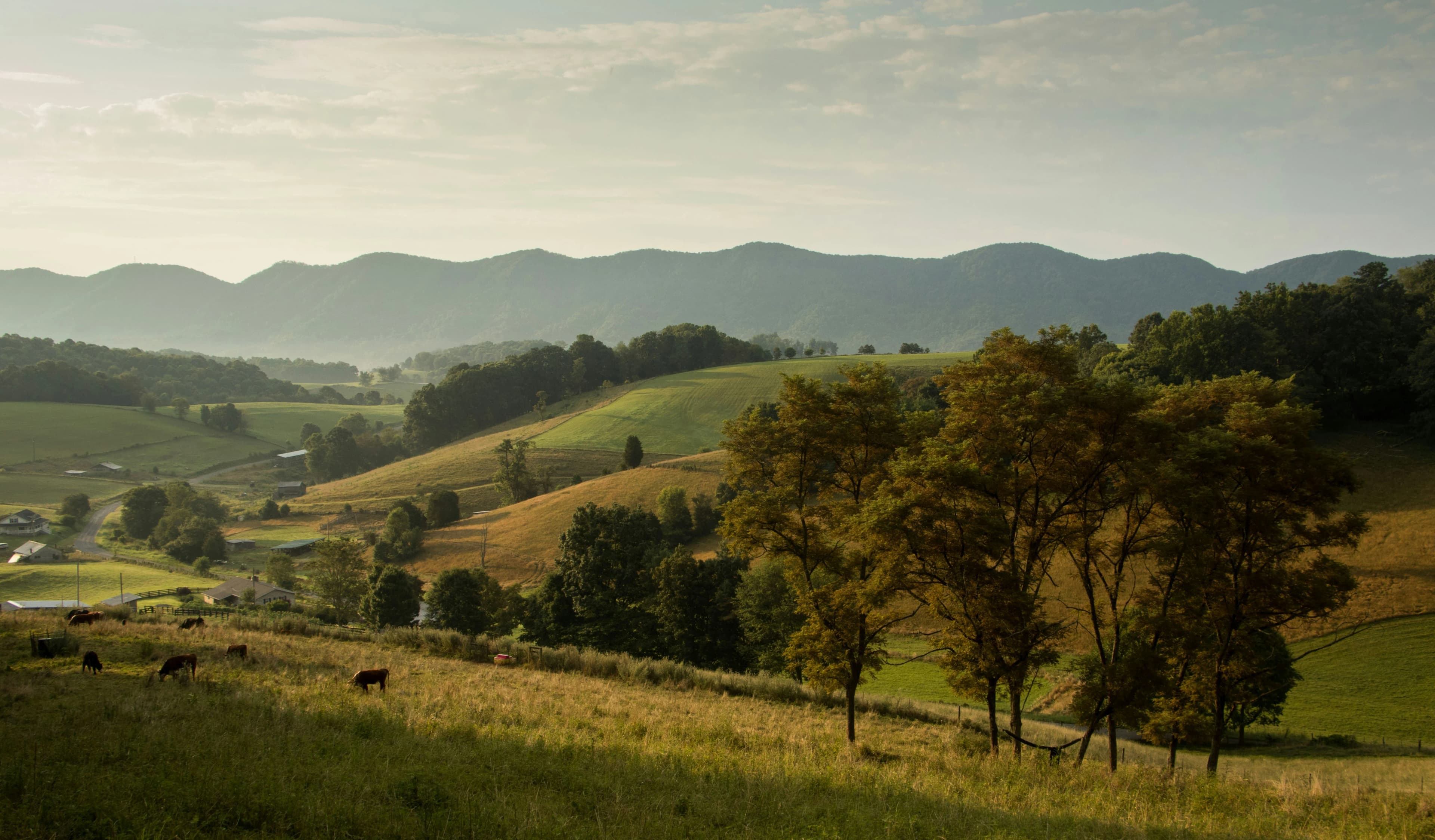
The western corridor, framed by the Blue Ridge Parkway and Shenandoah National Park, is Virginia's most architecturally dramatic landscape. Stays here are defined by elevation, privacy, and proximity to trails, vineyards, and agricultural estates. Suites in this region tend to occupy converted historic properties or purpose-built lodges with panoramic orientations. The traveler drawn to this area prioritizes quiet, territorial views, and the particular quality of light that moves across a mountain ridge at dusk.
The Virginia piedmont and wine country
Albemarle County and the surrounding piedmont, anchored by Charlottesville, constitute one of the most intellectually serious wine-producing regions in the eastern United States. Thomas Jefferson's Monticello sits at the cultural center of this landscape, and the architecture of the broader area reflects a Jeffersonian influence: red brick, symmetrical facades, and considered proportions. Luxury hotel suites in the piedmont tend to emphasize this historicism, placing guests within working estates or restored manor houses where viticulture and architecture are inseparable from the guest experience.
Northern Virginia and the D.C. proximity corridor
The northern counties, sharing a border with Washington D.C., serve a traveler with different priorities: government affairs, corporate travel, and access to the capital's cultural institutions. Suites in this corridor tend toward contemporary design and operational precision. The luxury standard here is measured in service efficiency, connectivity, and the ability to maintain a professional schedule without friction. Properties in Alexandria and Arlington carry an additional layer of Federal-era architecture that distinguishes them from generic business hotels.
The Tidewater and Virginia Beach coastal zone
Virginia's eastern coast, encompassing the Chesapeake Bay estuary and the Atlantic-facing shore at Virginia Beach, offers a maritime register distinct from the state's interior. Suites here are oriented toward water access, whether that means bay-facing terraces or direct Atlantic frontage. The seafood culture of the Chesapeake watershed, the naval history of Norfolk, and the colonial port character of Williamsburg create a coastal zone with unusual cultural density for a beach destination.
When to visit Virginia for a luxury suite stay
Virginia operates on four distinct seasonal registers, each affecting suite availability, landscape character, and the cultural calendar.
Spring, from late March through May, is the period of peak visual interest in the piedmont and mountain regions. Dogwood and redbud bloom across the foothills, and the wine country hosts its first major estate events of the year. Suite rates at mountain and vineyard properties rise accordingly, and advance planning is essential for the best addresses.
Summer concentrates travel toward the coast and the Blue Ridge. The Shenandoah Valley is warm but manageable at elevation, and the cultural calendar of Charlottesville includes music festivals and university-affiliated programming. Coastal suites in this period require the most lead time, particularly for waterfront properties on the Chesapeake Bay.
Autumn is arguably Virginia's most operationally significant luxury season. The Blue Ridge enters full foliage transformation from mid-October, and piedmont harvest events at the major wineries draw a sophisticated regional audience. Suite availability at vineyard estates contracts sharply during this window, making early reservation essential.
Winter brings a quieter register to most of the state. Rates moderate at mountain and rural properties, and the northern Virginia corridor maintains consistent demand due to proximity to Washington D.C. The colonial historic sites, particularly Colonial Williamsburg, carry a specific atmospheric weight in the colder months that appeals to culturally motivated travelers.
Understanding Virginia's luxury hospitality standards
Virginia does not operate under a formal national prestige designation equivalent to France's Palace classification. The relevant quality indicators are instead structural and historical. Properties that carry AAA Five Diamond ratings represent the benchmark for full-service luxury in the state, though this designation is applied sparingly and reviewed annually.
The more culturally significant category in Virginia is the historic property: inns, manors, and plantation-era estates that have been converted to hotel use with varying degrees of contemporary intervention. The quality of this conversion is the decisive factor. A well-restored 18th-century manor with considered suite design and professional service infrastructure represents a categorically different experience from a historic building that has been superficially updated.
Forbes Travel Guide star ratings provide an additional international frame of reference for travelers accustomed to evaluating luxury hotels globally. Five-star properties in Virginia are concentrated in the Northern Virginia and Richmond corridors, with a smaller number of resort properties reaching this designation in the mountain and coastal zones.
What distinguishes the best luxury hotel suites in Virginia from comparable American destinations is the architectural continuity between built environment and landscape. The state's tradition of Georgian and Federal architecture creates an interior design logic that the best properties extend into their suite programming: proportion, material quality, and a restraint that reads as considered rather than minimal.
How to choose the right luxury suite in Virginia
The decision architecture for a Virginia suite begins with a geographic question, not a price question. The state's luxury properties are distributed across landscapes with fundamentally different experiential propositions, and the choice of region determines everything that follows.
For travelers prioritizing landscape immersion and physical activity (hiking, cycling, equestrian pursuits), the Blue Ridge and Shenandoah corridor is the appropriate frame. Suites here should be evaluated on their orientation, the quality of outdoor access they provide, and the degree to which the property's programming integrates with the surrounding terrain.
For travelers motivated by cultural and intellectual programming, the piedmont and Charlottesville area offers the most coherent package: proximity to significant historic sites, a mature wine culture, and a university town that supports a year-round calendar of music, art, and public discourse.
For travelers whose Virginia stay is structured around Washington D.C. access, the northern corridor properties prioritize operational excellence over landscape. Here, suite selection should weight service standards, in-room workspace quality, and the property's relationship to ground transportation.
Across all regions, the practical considerations specific to Virginia include: the prevalence of historic structures that may limit certain accessibility requirements, the seasonal variability of rural road conditions in mountain properties, and the relatively concentrated window of peak availability during October foliage season.
The value of a curated selection by La Suite in Virginia
Virginia's luxury suite market is geographically dispersed and architecturally heterogeneous. A traveler approaching the state without prior knowledge faces a selection problem: the relevant properties are distributed across five or six distinct subregions, each operating on different seasonal rhythms and service models.
La Suite's curatorial approach addresses this directly. Rather than aggregating all available inventory, the platform applies a consistent editorial standard that accounts for architectural integrity, suite design quality, service infrastructure, and landscape positioning. The result is a selection that reflects the actual range of serious luxury options in Virginia, organized by the geographic and experiential criteria that matter to a discerning traveler.
For a destination like Virginia, where the difference between a genuinely exceptional property and a merely expensive one is often invisible in standard booking interfaces, this curation function has direct practical value. La Suite provides the geographic and qualitative context that allows a traveler to make a decision aligned with the specific kind of experience they are seeking.