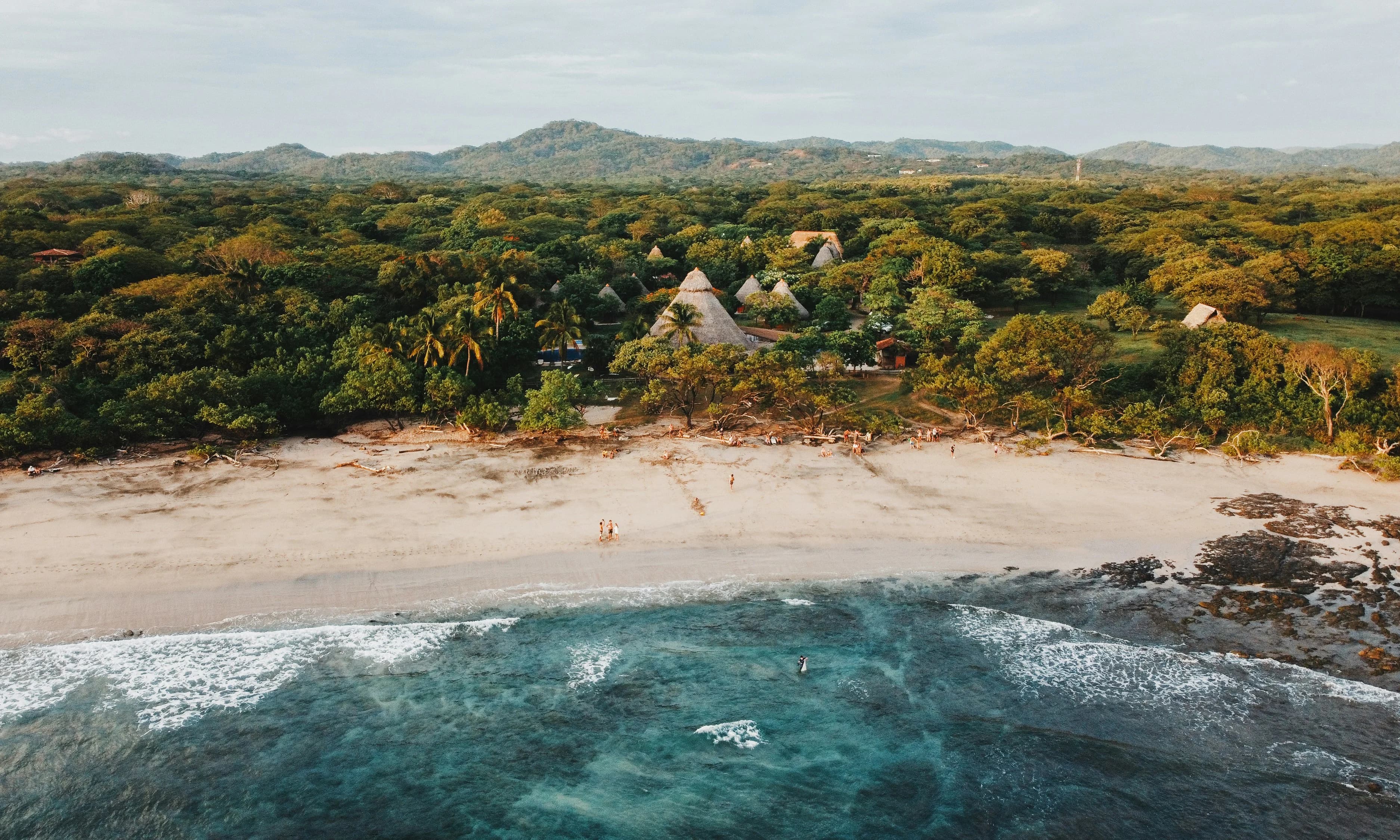
AIRE Jungle Boutique Hotel, Talamanca
Located in Puerto Viejo, 1.7 miles from Punta Uva Beach, AIRE Jungle Boutique Hotel provides accommodations with a garden, free private parking and a terrace. Guests can use the indoor pool, or enjoy

Costa Rica divides naturally into distinct geographic zones, each offering a different sensory register and a different logic for selecting where to stay.
33 hotels available

Located in Puerto Viejo, 1.7 miles from Punta Uva Beach, AIRE Jungle Boutique Hotel provides accommodations with a garden, free private parking and a terrace. Guests can use the indoor pool, or enjoy

Located in Playa Hermosa, a 6-minute walk from Hermosa Beach, Amarena Canvas Beach Hotel has accommodations with free bikes, free private parking, an outdoor swimming pool and a garden. Among the faci

Located in Santa Teresa Beach, a few steps from Playa Hermosa, Blue Mist Hotel- Adults Only provides accommodations with an outdoor swimming pool, free private parking, a garden and a private beach ar

This property is a beachfront hotel that has an outdoor pool, spa facilities and massage services. It also features meeting rooms, gardens and on-site shops. The hotel offers Wi-Fi in the business cen
Located in Nosara, a 11-minute walk from Pelada Beach, Domo Nosara Boutique Hotel has accommodations with a garden and free private parking. Featuring an outdoor swimming pool, the 4-star hotel has ai

Located in Guácimo, 15 miles from Ebal Rodriguez Stadium, Ecolirios Boutique Hotel & Villas has accommodations with free bikes, free private parking, a garden and a terrace. Each room at the 5-star ho

Located 2 miles from La Selva Biological Station, El Lugar Costa Rica Resort offers 4-star accommodations in Tigre and has an outdoor swimming pool, a restaurant and a bar. Offering massage services,

Set in Costa Rica’s Central Volcanic Valley, El Silencio Lodge & Spa Costa Rica features 500 acres of private tropical forest reserve. It offers a spa and stylish Suites with stunning mountain views.

Epic Tamarindo Boutique Hotel in Tamarindo features 5-star accommodations with an outdoor swimming pool, a garden and a shared lounge. Among the facilities at this property are a concierge service and

Esh Hotel & Spa, a Member of Design Hotels has a garden, shared lounge, a terrace and restaurant in Nosara. Featuring an outdoor swimming pool, the 5-star hotel has air-conditioned rooms with free WiF

Featuring a terrace, bar and views of city, Hilton San Jose La Sabana is located in San José, 29 miles from Poas National Park. Offering a restaurant, the property also has a fitness center, as well a

Located in Santa Teresa Beach, a few steps from Santa Teresa Beach, Hotel Fermata has accommodations with an outdoor swimming pool, free private parking, a garden and a terrace. Featuring a restaurant

Boasting a garden and terrace, as well as a restaurant, Koora Monteverde a Cloud Forest Hotel by Sandglass is set in Monteverde Costa Rica. This 5-star hotel offers a bar. The accommodations offers fr

Kura Boutique Hotel Member of the Cayuga Collection by Cayuga Collection in Uvita provides adults-only accommodations with a garden and a bar. Featuring an outdoor swimming pool, the 5-star hotel has

Located in Santa Teresa Beach, a 15-minute walk from Santa Teresa Beach, LALOON Luxury Suites - Adults Only provides accommodations with an outdoor swimming pool, free private parking and a terrace. T

Los Altos Beach Resort & Spa is located in Manuel Antonio and offers luxurious suites with a fully-equipped kitchen and balcony. The hotel has free Wi-Fi and an outdoor pool. The design suites at Los

Located in Herradura, Puntarenas region, Marriott Vacation Club at Los Sueños is located 656 feet from Playa Herradura. At the resort, the rooms have a balcony. The nearest airport is Tambor Airport

Located in Monteverde, Costa Rica. This lodge is located 15 minutes’ drive from the Monteverde Biological Reserve and 0.6 mi from Monteverde Town Center. It features an extensive garden with a heated

Located in Puerto Viejo, a 3-minute walk from Negra Beach, Namu Garden Hotel & Spa - Adults Only provides accommodations with an outdoor swimming pool, free private parking, a garden and a restaurant.

Nayara Gardens is a luxury boutique hotel and spa set against the panoramic backdrop of the Arenal Volcano, surrounded by Costa Rican Rainforest. Private bungalows have a private terrace with a plunge
The northwest Pacific coast is the country's most established luxury corridor. The Nicoya Peninsula concentrates a high density of design-forward properties along clifftop and beachfront positions. Guanacaste's dry tropical forest and long Pacific swells attract a well-travelled clientele seeking warm, dry conditions and direct ocean access. Suites in this zone tend toward open-plan pavilion architecture, with infinity pools oriented toward sunset exposure over the Pacific. The region's international airport at Liberia makes access straightforward without transiting San José.
The Osa Peninsula, bordering Corcovado National Park, represents a more deliberate choice. One of the most biodiverse territories on the planet, it demands a commitment: access requires a domestic flight or a multi-hour drive, and properties here are deliberately intimate. Suites in the Osa are typically elevated structures embedded in primary rainforest, where acoustics, humidity, and wildlife proximity define the experience as much as the interior design. This is the correct address for travelers who prioritise ecological immersion over convenience.
The Central Valley, where San José sits at approximately 1,100 metres elevation, offers a temperate base with access to cultural and gastronomic infrastructure. The Arenal Volcano zone, further north, draws visitors to its thermal hot springs and lake views. Luxury properties here leverage the volcanic landscape directly, with suites positioned to frame the cone or access private thermal pools. The perpetual cloud activity around Arenal creates a dramatically shifting visual environment that more coastal properties cannot replicate.
The Caribbean side of Costa Rica, centred around the Tortuguero canals and the southern Talamanca coast, operates on a different rhythm. Rainfall is higher, the jungle denser, and the cultural influence draws from Afro-Caribbean traditions rather than the Spanish colonial heritage of the Pacific. Properties here are fewer and more selective, rewarding travelers who seek an experience distinct from the polished Pacific corridor.
Costa Rica's climate divides into two seasons: the dry season (roughly December through April) and the green season (May through November). The logic for suite travellers is not identical to the logic for general tourists.
The dry season, particularly January through March, represents peak demand. Availability at the most sought-after properties tightens considerably, and advance planning of several months is standard practice for the top suites. The Pacific beaches are consistently accessible, and visibility conditions for wildlife observation are generally clear.
The green season, often marketed as the rainy season, carries a different appeal for discerning travelers. Rates adjust downward at many properties, competition for the finest suites eases, and the landscape reaches its most saturated intensity. Rainfall typically arrives in the afternoons, leaving mornings clear. The turtle nesting season on the Caribbean coast runs roughly from March through October, and the Osa Peninsula's rivers run at their most impressive volume. Many experienced luxury travelers deliberately select the shoulder months of May, June, or November for this combination of conditions and value.
Costa Rica does not operate within a formal national luxury classification equivalent to the French Palace designation or the Italian system. Star ratings exist but function more as administrative categories than meaningful indicators of suite quality. The relevant indicators for discerning travelers are different.
The country's finest properties are frequently members of international luxury collections and are subject to independent auditing. More practically, the defining standard for a high-quality suite in Costa Rica is the relationship between interior space and the surrounding environment. Properties that interrupt the jungle canopy view with construction-phase finishes, or that rely on generic furnishings rather than locally sourced materials, represent a lower tier regardless of their stated category.
Genuine top-tier suites in Costa Rica typically feature: private plunge pools or direct access to thermal or natural water features; architecture that prioritises natural ventilation while providing functional air conditioning as a secondary option; materials drawn from regional timber traditions combined with contemporary specifications; and staff-to-guest ratios high enough to support genuinely personalised service, including naturalist guides, private transfer logistics, and chef-driven private dining.
Sustainability credentials have become a meaningful differentiator at the upper end of the market. The Certification for Sustainable Tourism (CST), administered by the Costa Rican Tourism Institute, provides a verifiable framework, though the most rigorous properties often hold additional international certifications alongside it.
The first decision is geographic, and it is consequential. Costa Rica is not a destination where a single base allows efficient access to multiple zones. The distances are manageable on a map but not always by road, and the country's terrain makes transfers longer than coordinates suggest. A traveller who wants both Pacific coast sunsets and Caribbean coast biodiversity should plan a multi-stop itinerary rather than a single property stay.
The second consideration is the degree of connectivity each property offers. Some of the country's finest suites are genuinely remote: accessible only by small aircraft or boat, with limited cell service and no urban infrastructure nearby. This is a deliberate choice that the property has made, and it shapes the entire experience. It suits one type of traveler and will frustrate another. Matching this variable correctly is more important than any amenity list.
Architecture style is a practical consideration rather than merely an aesthetic one. Elevated structures on stilts allow wildlife movement beneath them and reduce the property's footprint, but they also mean navigating stairs with luggage. Open-air bathrooms and partially open bedrooms require comfort with ambient humidity and sound. A suite facing east captures dawn light over the jungle but misses Pacific sunsets entirely. These are parameters worth clarifying before committing.
The Costa Rican hotel market has expanded rapidly alongside the country's reputation for ecotourism. The distance between a property that uses the language of sustainability and design and one that genuinely delivers it at suite level is significant. Marketing materials across the sector have converged on similar imagery: canopy views, infinity pools, resident wildlife. The actual experience diverges considerably.
La Suite applies a consistent editorial and experiential standard to its selection process, filtering for properties where the suite product specifically (not just the property in general) meets the criteria that define the category: spatial quality, architectural coherence, service depth, and genuine integration with the landscape. The curated selection by La Suite in Costa Rica is designed to remove the research burden and reduce the margin for disappointment in a market where the gap between expectation and reality is unusually wide.
The Nicoya Peninsula and Guanacaste coastline on the Pacific side offer the highest concentration of luxury properties with direct ocean exposure and clifftop positioning. Suites in this corridor are designed specifically to capture Pacific sunset views and are generally more accessible than properties on the Osa Peninsula. Availability at the top addresses tightens between January and March, so advance planning is advisable.
For the most in-demand properties during the dry season (December through April), a planning horizon of three to six months is standard. Peak weeks around the Christmas and New Year period at top-tier properties can require reservations up to a year ahead. The green season from May through November offers more flexibility and is worth serious consideration for experienced travelers.
Many of Costa Rica's finest properties offer suite configurations designed for families, including multi-bedroom layouts and private pool access that provide both space and safety. The most suitable options tend to be on the Pacific coast, where infrastructure and accessibility are more developed. Properties in truly remote areas such as the Osa Peninsula may have age restrictions or logistical constraints worth confirming directly.
The Certification for Sustainable Tourism (CST), issued by the Costa Rican Tourism Institute (ICT), provides a nationally recognised baseline on a scale of one to five levels. Properties operating at the highest suite tier frequently hold additional international certifications. Genuine sustainability at a luxury property level involves material sourcing, energy systems, water management, and community employment practices, not only wildlife observation programmes.
The dry season (December through April) offers consistent Pacific coast beach conditions and peak availability of wildlife observation activities, but it also concentrates demand and compresses availability at the finest properties. The green season (May through November) brings afternoon rainfall, lush landscape saturation, reduced competition for suites at top properties, and in some zones access to events such as turtle nesting. Many discerning travelers prefer the shoulder months of May, June, or November.
Yes, a significant number of high-calibre properties are reachable by road from either Liberia (for Guanacaste and the Nicoya Peninsula) or San José (for the Central Valley, Arenal, and parts of the Pacific coast). The Osa Peninsula is the primary zone where a domestic flight substantially reduces transfer time. Travel times in Costa Rica are frequently longer than distances suggest due to road quality and terrain.
The most considered properties work with elevated pavilion structures, locally sourced hardwoods, and maximally open facades designed for natural ventilation. The goal is architectural permeability with the landscape rather than isolation from it. Better suites typically incorporate private outdoor bathing spaces, jungle or ocean framing through full-height openings, and materials that reference regional craft traditions without resorting to decorative cliché.
The Caribbean coast offers a genuinely distinct experience from the Pacific, with a different ecosystem, cultural register, and rainfall pattern. The infrastructure for luxury travel is more limited than on the Pacific side, and properties are fewer. For travelers specifically interested in canal ecosystems, Afro-Caribbean cultural heritage, or the Talamanca coastline, it represents a compelling and underexplored option at the high end of the market.
Costa Rica's upper tier of suite properties occupies a distinctive position in the regional market, defined by a higher density of ecologically integrated architecture and a more established tradition of high-service lodge hospitality than most of its Central American neighbours. The country's political stability, well-developed national park system, and international air connectivity contribute to a reliability of experience that is not uniformly present elsewhere in the region.
The finest properties offer in-suite dining drawing on Costa Rica's agricultural biodiversity, including cacao from the Caribbean coast, tropical fruits, fresh Pacific seafood, and locally produced coffee from the Central Valley highlands. Private chef experiences and guided market visits are available at select properties. The country does not have an internationally recognised fine dining tradition at the same level as Peru or Mexico, but the raw material quality at top-tier suite hotels is consistently high.