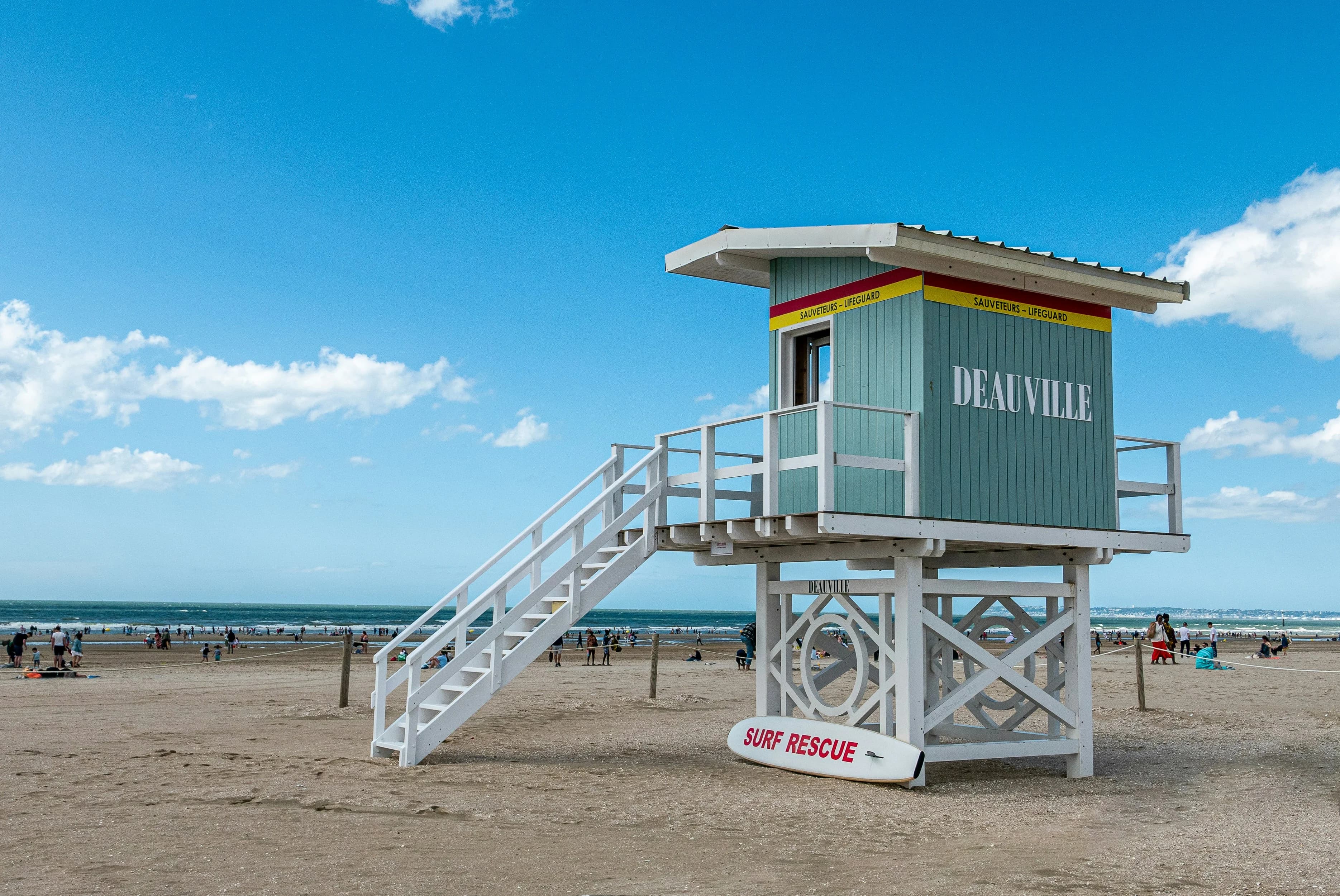
Understanding Deauville as a luxury destination
For high-end travelers, this coherence matters. A luxury hotel suite here is not an isolated bubble but a node within a designed environment. The experience of Deauville is fundamentally architectural and social, shaped by a civic culture of horse racing, film (the American Film Festival in September draws significant international attention), and a certain Parisian propriety transplanted to the coast.
Best areas to stay in Deauville
The beachfront and the planches
The boardwalk, known locally as Les Planches, remains the defining promenade of Deauville. Hotels positioned along or adjacent to this axis offer direct visual access to the beach and the channel horizon. The light here, typical of the Normandy coast, is diffuse and photogenic in equal measure, particularly in the hours around dawn and late afternoon. Suites facing the sea in this zone capture that quality of northern coastal light that Norman painters documented extensively in the nineteenth century.
The racing quarter and the town centre
Deauville's twin racecourses, La Touques and Clairefontaine, anchor the town's equestrian identity. The area surrounding the racecourse and the central casino sits at a slight remove from the beach and offers a different register: more enclosed, more architectural, more oriented toward the social rituals of the racing season. Suites in the town centre proper tend to occupy historic structures and deliver a sense of period grandeur that beachfront properties sometimes trade for views.
The Trouville border
Deauville shares a riverbank with Trouville-sur-Mer, separated only by the Touques estuary. The two towns are different in character: Trouville is older, less manicured, more popular with French families seeking a less formal coast. Travelers staying on the Deauville side gain easy pedestrian access to Trouville's fish market and its distinct atmosphere, which provides useful contrast without sacrificing the quieter register of Deauville proper.
When to visit Deauville
The Deauville calendar is structured around three anchors that shape both atmosphere and hotel availability. The summer racing season, which runs through July and August, represents peak demand. The Deauville American Film Festival in early September brings a culturally distinct crowd and considerable media presence, with hotel occupancy matching or exceeding summer levels. The spring season, particularly May and June, offers a quieter cadence with the town still fully operational but less pressured.
Outside these windows, Deauville operates in a lower register that some travelers actively prefer. October through March is quieter, the coast takes on a grayer, more introspective quality, and rates across the hotel market tend to reflect the reduced demand. For travelers drawn to Deauville's architectural personality rather than its social calendar, the off-season presents a more considered proposition.
The Norman climate is temperate and maritime. Rain is plausible at any time of year. Packing accordingly is not optional; it is simply part of engaging with this coast on its own terms.
Local luxury standards: what to expect from top-tier suites in Deauville
France maintains a formal classification for its most prestigious hotels: the Palace designation, awarded by Atout France to properties meeting criteria across service, architecture, historical significance and cultural contribution. Deauville hosts properties that have historically competed within this framework, though the Palace label is contested and periodically reviewed. Travelers should use it as a directional indicator rather than a guarantee.
Beyond formal classification, the defining characteristics of a luxury hotel suite in Deauville tend to reflect the town's own aesthetic: a preference for classical proportions, for period detailing, and for a kind of restrained grandeur that avoids ostentatious flourish. Suites here are more likely to deliver coffered ceilings and parquet floors than the minimal-concrete aesthetic that dominates contemporary luxury in other markets. This is a feature for travelers attuned to European hotel culture, not a limitation.
Service culture in Deauville's top hotels draws on the Parisian grand hotel tradition. Discretion is valued over performative hospitality. Staff familiarity with equestrian schedules, casino protocols and local dining rituals is generally high. Guests who communicate specific preferences in advance tend to extract the most from these properties.
How to choose the best suite in Deauville
Sea view versus garden or courtyard orientation
The choice between a sea-facing suite and one oriented toward the hotel's interior gardens or the town itself is genuinely consequential in Deauville. Sea-facing rooms deliver the Norman light and the sensory register of the channel. Interior suites tend to be quieter, sometimes more architecturally intact, and are often preferred by guests prioritising sleep quality and privacy over views.
Historic structure versus contemporary renovation
Several of Deauville's most prominent hotels occupy buildings dating from the late nineteenth and early twentieth century. The quality of renovation varies considerably. Some properties have maintained original architectural features with care; others have standardised their interiors toward a generic luxury brief. Requesting specific information about the suite's original features and any recent renovation work is reasonable and will typically be answered directly by a hotel concierge.
Proximity to the racecourse during peak season
During the August racing season, properties close to the racecourse experience elevated noise and foot traffic on race days. For travelers visiting specifically for the racing, this proximity is desirable. For those seeking quiet, a suite at a slight distance from the racing quarter, even within walking range, is worth specifying.
The value of curation in Deauville
Deauville's hotel market is relatively small and, at the top end, concentrated among a handful of historic addresses. This apparent simplicity conceals meaningful differences in suite quality, service standard and seasonal availability. The distinction between a suite that is merely expensive and one that is architecturally coherent, well-staffed and positioned correctly for a given travel brief is not always evident from hotel websites or general booking platforms.
La Suite applies a consistent editorial framework to this market: cross-referencing physical inspection data, guest feedback from a peer-level audience, and knowledge of how specific suites perform across different seasons and travel configurations. For a town like Deauville, where reputation and reality do not always align, this layer of curation is not decorative. It is the difference between arriving at a property that matches the expectation and one that trades on historical prestige without maintaining the standards that justified it.