Understanding Honfleur as a luxury destination
Best areas to stay in Honfleur
Around the Vieux-Bassin
The old harbour is the gravitational centre of Honfleur. Properties within a short radius of the Vieux-Bassin place guests at the intersection of the town's visual and social life. The narrow, vertically stacked houses that frame the basin on the Quai Sainte-Catherine side are among the most photographed architectural compositions in Normandy. Proximity to this area means access to the town's best independent restaurants, Norman cider bars and the Musée Eugène Boudin on foot.
The hillside and Côte de Grâce
Rising above the harbour, the Côte de Grâce offers a different register entirely. The hilltop chapel of Notre-Dame de Grâce has been a pilgrimage site since the 17th century, and the elevated position provides sweeping views over the Seine estuary and, on clear days, across to Le Havre. Boutique properties in this zone tend toward the residential and the discreet, appealing to travellers who prefer calm over proximity to the harbour's evening activity.
The periphery and apple orchards
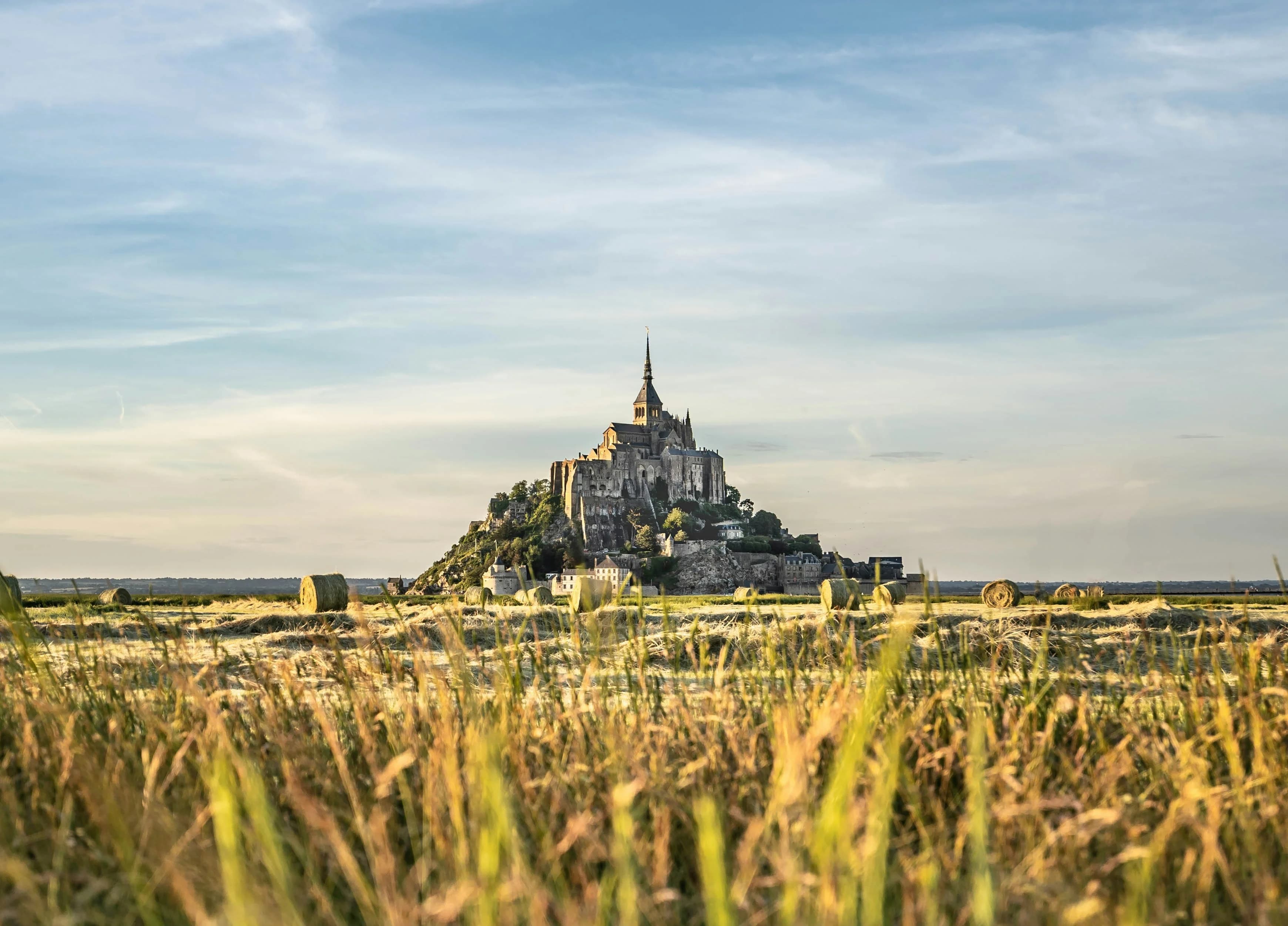
Honfleur sits at the edge of the Pays d'Auge, Normandy's most celebrated agricultural interior, defined by bocage landscapes, half-timbered farmhouses and the orchards that produce Calvados, Pays d'Auge AOC apple brandy and Camembert. Properties slightly outside the town's historic core, set within this rural context, offer a different version of Norman luxury: space, silence and direct access to the regional produce that defines the area's gastronomy.
When to visit Honfleur for a suite stay
Honfleur operates on a markedly seasonal rhythm. The peak months of July and August bring high occupancy and elevated prices across all accommodation categories, and the harbour area becomes genuinely crowded. For travellers prioritising space and quality of experience, the shoulder seasons are more calibrated choices.
May and June offer long Atlantic daylight, flowering Norman countryside and availability at properties that sell out entirely in summer. September and early October extend the season with harvest activity in the Pays d'Auge, calvados distillery visits and a perceptible shift in the light that made this coastline famous among painters. The Pentecost weekend (Fête des marins, or Blessing of the Sea) held in Honfleur draws significant regional attendance and is worth planning around either deliberately or by avoidance, depending on preference.
Winter in Honfleur is intimate and largely unvisited. The town's architecture reads differently without tourist foot traffic, and several of its better restaurants maintain their kitchens year-round for a local clientele. Suite rates in this period reflect the reduced demand, making it a pragmatic window for travellers with schedule flexibility.
Local luxury standards: what to expect from top-tier properties in Honfleur
Honfleur does not operate at the scale that supports a Palace-category hotel in the sense defined by Atout France, the national tourism authority whose Palace label (distinct from and above the five-star classification) is reserved for properties meeting exacting criteria of space, service ratio and heritage. Parisian Palaces and a handful of properties in Cannes, Biarritz and the Loire Valley hold this designation. Honfleur's offer is different in character but not inferior in intent.
The town's finest properties are typically smaller in scale: manor houses, converted merchant residences and carefully restored Norman longères (traditional single-storey farmhouses). The luxury here is expressed through material quality, architectural integrity, culinary sourcing and the particular density of attention that smaller properties can deliver. Suites in this context often feature exposed timber beams, stone fireplaces, slate or terracotta flooring, and views calibrated to the specific geography: harbour, estuary or orchard. The Norman palette is restrained and tactile rather than decorative.
Gastronomic standards are high and locally anchored. The region produces butter (Isigny AOP), cream, aged Livarot and Pont-l'Évêque cheeses, Atlantic fish from the nearby Fécamp and Trouville markets, and the full range of apple distillates. Properties at the upper end of the market reflect this sourcing in their breakfast and dinner offerings, and proximity to chefs trained in the Norman tradition, several of whom hold Michelin recognition in the wider Calvados department, is a consideration in selecting where to stay.
How to choose the best suite in Honfleur
Historical architecture versus contemporary fit-out
Honfleur's historic building stock imposes specific spatial constraints. Rooms in converted 17th or 18th-century merchant houses tend toward verticality rather than horizontal spread, with steep internal staircases and irregular floor plans. Travellers for whom suite size in square metres is the primary metric should verify dimensions carefully. Those who prioritise atmosphere, material authenticity and architectural character will find the town's older properties compelling precisely because of these particularities.
Harbour view versus interior quiet
Suites facing the Vieux-Bassin deliver a visual payoff that is genuinely difficult to replicate elsewhere in Normandy. The evening light on the slate facades, the movement of the tide and the specific urban scale of the harbour basin are all legible from a well-positioned room. However, the harbour perimeter generates noise: restaurant terraces, pedestrian traffic and, in summer, outdoor entertainment. Travellers with sensitivity to sound should consider properties one or two streets removed from the quay, where the visual access is partly reduced but the acoustic environment is significantly calmer.
Access and arrival logistics
Honfleur is reached from Paris in approximately two hours by road via the A13 and A29 motorways, crossing the Pont de Normandie, the cable-stayed bridge over the Seine estuary opened in 1995. There is no direct rail connection to Honfleur itself. The nearest TGV-served station is Lisieux, approximately 35 kilometres inland. Travellers arriving without a vehicle should confirm transfer arrangements with their property in advance, as local taxi infrastructure is limited relative to demand in peak season.
Why curation matters in Honfleur
Honfleur's small scale creates a paradox for the independent traveller. The town has very few properties operating at a genuinely high standard, and those that do are rarely prominently represented on mainstream booking platforms, which weight volume and review count over editorial quality. The risk of selecting an average property in a premium location is real and common.
La Suite's curated selection applies a consistent set of criteria: architectural quality, suite dimensions and fit-out, sourcing standards in the kitchen, service attentiveness and the specific sense of place that separates a considered property from a decorated one. In a market as compact as Honfleur, that editorial layer is not a convenience. It is the difference between an ordinary stay in a remarkable location and an experience commensurate with both the destination and the traveller's expectations.