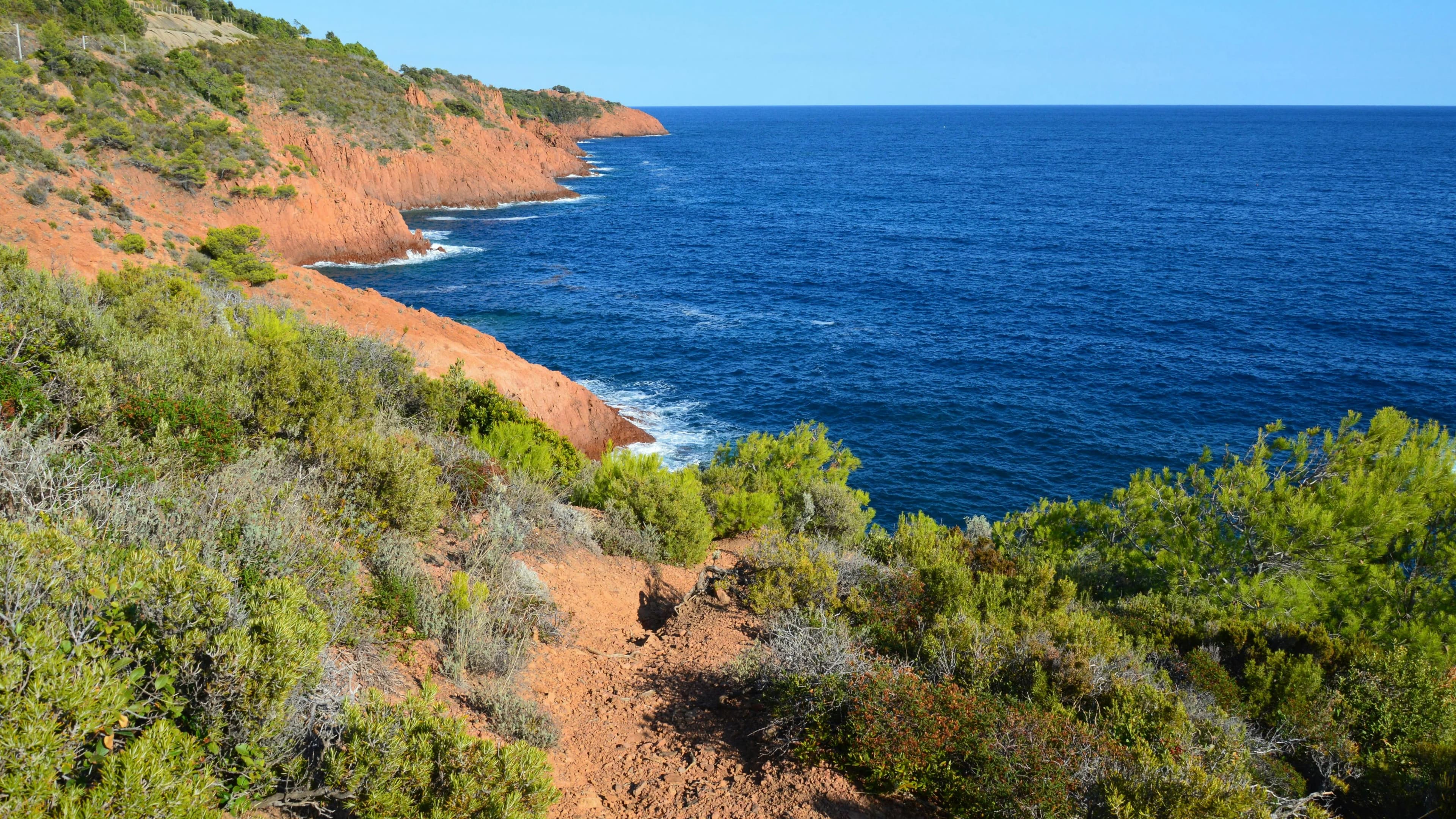
Where to stay in Théoule-sur-Mer and the surrounding Esterel coast
La Galère, the area developed in part around the sculptural architecture of Jacques Couëlle, draws travelers with a specific appetite for organic, cave-like structures built directly into the rock face. Properties here feel geological rather than constructed, and suites with direct sea access offer an intimacy with the water that more formal resort architecture rarely achieves.
Miramar, slightly further along the corniche, carries a more classical Riviera register. The orientation toward the Lérins Islands and the distant silhouette of Cannes gives it a panoramic quality. For travelers seeking broader horizon lines and a sense of territorial overview, this stretch rewards attention.
The area between Théoule proper and the Pointe de l'Aiguille is the most sheltered, with calmer waters and a village-scale atmosphere that contrasts sharply with the surrounding wild coastline. Families and travelers arriving by yacht tend to gravitate here for its practicality alongside its discretion.
When to visit Théoule-sur-Mer for a luxury stay
The Esterel coast operates on a climate that is measurably different from the western Provence interior. The proximity to the sea moderates temperature extremes, and the rocky terrain retains heat in a way that extends the comfortable season well into October and allows early-season arrivals from late March onward.
June and September represent the most considered months for a high-end stay. The light in these shoulder periods has a quality that July and August cannot match: clearer, lower in angle, and without the atmospheric haze that the peak summer heat generates. Suite availability is also broader, and the absence of high-season density changes the entire acoustic environment of the coast.
July and August concentrate the Cannes film industry adjacency, with significant movement between Théoule, Cannes, and the Lérins Islands. The Cannes Lions festival in June and the Cannes Film Festival in May draw an international creative and commercial audience to the region. Travelers who time their stay around these events gain access to a specific social and cultural layer of the Côte d'Azur that is otherwise dormant.
Winter on this coast is underrated. From November through February, the Esterel becomes almost entirely private. The red cliffs against a cold-season sky, the empty corniches, and the reduced hotel occupancy create conditions that certain travelers find more compelling than any summer offering.
Luxury standards and what to expect from top-tier suites in this area
The French hospitality classification system awards the Palace designation to a small number of establishments that meet criteria across service, architecture, F&B, and cultural contribution. On the Esterel coast, this designation is rare, which concentrates the luxury offer around boutique properties and architecturally distinctive hotels that operate at a high standard without the institutional scale of a Palace property.
What distinguishes suites in this area is predominantly the relationship between the interior and the exterior. The Mediterranean light and the geological drama of the Esterel mean that any suite of real quality must engage the view as a primary design element, not as an incidental amenity. Terraces, infinity-edge pools connected to suite access, and glass-fronted facades are structural commitments, not optional upgrades.
Service ratios in smaller coastal properties here tend to be high relative to room count, which translates into a more personalised rhythm of interaction than a large resort can sustain. Concierge access to private boat hire, direct coordination with local Michelin-recognised restaurants in nearby Mandelieu-la-Napoule or Cannes, and arrangements for Esterel trail access are the practical markers of a well-run property at this level.
How to choose the right luxury suite in Théoule-sur-Mer
The most consequential decision when selecting a suite in this area is the orientation and floor elevation. Due to the steep cliff topography, even a modest difference in room level can produce a dramatically different relationship with the horizon. A ground-level suite with direct sea access reads entirely differently from a suite positioned above the canopy line with an unobstructed panorama. Neither is categorically superior, but each corresponds to a different mode of experience.
Architecture is the second filter. The Couëlle-influenced organic structures in La Galère are experientially immersive but can read as unconventional to travelers expecting classical Riviera elegance. More traditional stone and whitewashed construction in the Miramar area will suit those whose preference is for a coherent visual language between the property and the broader Mediterranean vernacular.
Practical access is worth considering carefully. Théoule-sur-Mer is served by a train station on the Cannes to Grasse line, which makes arrival without a vehicle straightforward. However, the fractured topography means that many properties sit above or below the main corniche road, and internal transfers between the suite and the coast can require planning. Properties that offer shuttle access to private moorings or to the village itself add a meaningful layer of operational ease.
For families or groups requiring multiple suite configurations within a single property, inventory depth matters. Many of the finest properties here are small by design, which means early engagement with availability is essential, particularly for peak season and around major events on the Cannes calendar.
Why curated selection by La Suite is the most efficient approach in this destination
Théoule-sur-Mer does not have the volume of luxury hotel infrastructure found in Cannes or Nice, which means that the margin for an uninformed booking is higher. The properties that perform at the level this coast demands are specific, and their distinctiveness is not always legible through standard travel platforms that aggregate across categories and price points.
La Suite applies a curatorial logic to this market that corresponds to how serious travelers actually make decisions: by architecture, by spatial experience, by service model, and by the relationship between the property and its landscape. The curated selection for Théoule-sur-Mer and the Esterel coast reflects these criteria precisely, removing the inefficiency of broad searches and positioning each option within the context it deserves.