Where to stay in Cheshire: distinct areas and their character
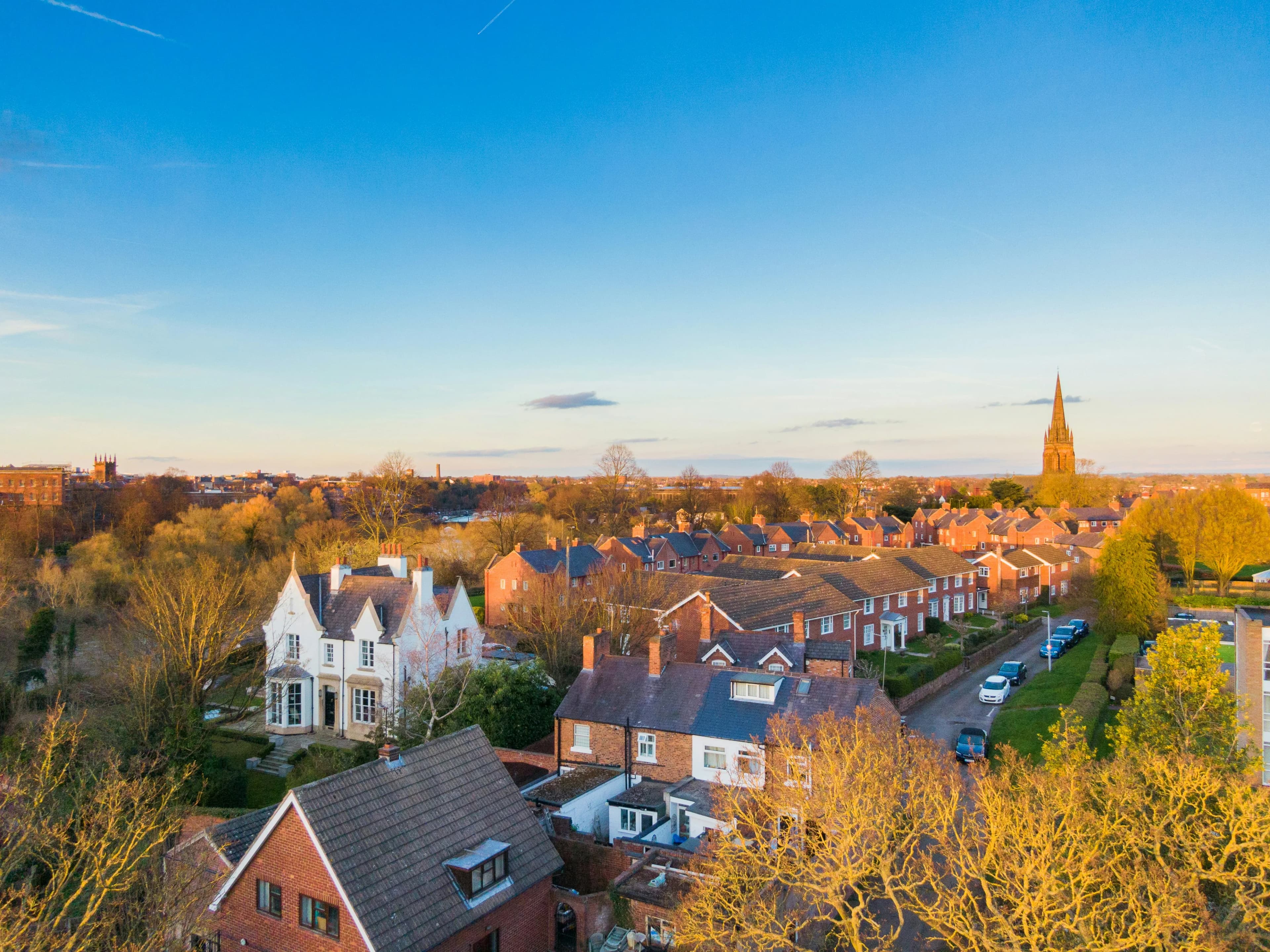
The north and east of the county, anchored by the Cheshire Plain, presents open agricultural land punctuated by black-and-white half-timbered villages and low sandstone ridges. Properties here tend toward the country house model: converted halls with formal gardens, walled grounds, and a sense of controlled seclusion. The aesthetic is Georgian and Victorian, with interiors that frequently reference the heritage of the buildings themselves.
The north-west corridor approaching Chester carries its own weight. Chester is among the best-preserved Roman and medieval walled cities in Britain. The surrounding countryside supports properties that position themselves as a natural counterpoint to the city: green belts and river meadows that create genuine quiet within minutes of historic streets.
The eastern fringe of Cheshire rises toward the Peak District foothills, where the character shifts. Stone replaces timber, terrain becomes more pronounced, and a handful of properties occupy elevated positions with long rural views. This part of the county suits travelers who want physical landscape as a component of the stay.
The so-called Golden Triangle, a loosely defined affluent corridor covering villages such as Alderley Edge, Prestbury, and Wilmslow, has a particular social geography. It is one of the wealthiest areas in the United Kingdom outside London, and the hospitality infrastructure reflects that. Restaurants, spas, and hotel properties here operate at a consistently high register, serving a clientele with exacting standards.
When to visit Cheshire for a luxury suite stay
Cheshire's temperate climate does not produce dramatic seasonal extremes, which makes it a viable destination across the calendar. That said, certain periods have clear advantages.
Late spring (May and June) brings the English countryside into full condition without the compressed school-holiday demand of July and August. Country house properties with formal gardens are at their best, and rural roads remain negotiable. Rates for luxury hotel suites tend to be more accessible than in peak summer.
Summer is anchored by the Royal Cheshire County Show, held annually in June at Tabley near Knutsford. This is one of the UK's largest agricultural shows and draws a significant regional crowd, which affects room availability in the county. The Chester Races, held across multiple meetings from May through September, are among the most socially prominent fixtures on the British flat racing calendar. Chester's racecourse is the oldest in England in continuous use, and race-day weekends tighten availability substantially at properties within reasonable distance of the city.
Autumn (September through November) is the least-discussed but often the most rewarding season for discerning travelers. Estate landscapes take on colour, shooting season begins, and several country house hotels activate field sports programmes for guests. Demand drops after September, and suite rates often reflect this.
Winter in Cheshire is mild compared with the north of England. Christmas markets in Chester are well-established and draw visitors across a six-week period, creating notable demand in December. January and February offer the deepest quiet and, for the right traveler, the most uninterrupted experience of the county.
Luxury standards in Cheshire: what to expect from top-tier suites
Cheshire does not have a formal prestige designation equivalent to France's Palace classification, but it operates within the standard UK hotel grading framework, supplemented by independent recognition from bodies such as the AA and membership in groups like Relais and Chateaux or Small Luxury Hotels of the World.
At the top of the market, Cheshire's best properties tend to be country house hotels: converted aristocratic seats or Victorian-era halls that have been sympathetically restored and repositioned as luxury hotel offerings. The architectural language is typically formal English: panelled rooms, stone-flagged corridors, original fireplaces, and high ceilings. Suites in these buildings are often individually designed, drawing on the history of the specific house rather than a brand-wide design template.
Spa infrastructure is a consistent feature at the county's leading properties. Cheshire's affluent residential base supports year-round spa demand, and several properties have invested significantly in thermal facilities, hydrotherapy pools, and treatment suites that compete with destination spa hotels elsewhere in Europe.
Dining standards in the top tier are serious. A number of Cheshire properties hold or have held Michelin recognition, and the general direction of fine dining across the county has moved decisively toward produce-led, seasonal menus sourced from local farms and estates. For guests staying in luxury hotel suites, in-room dining at this level is not an afterthought but a considered service.
How to choose the right luxury suite in Cheshire
The first question is whether you want a historic building or a contemporary interior. Cheshire's stock of converted country houses is substantial, and many travelers come specifically for the experience of staying in a building with genuine architectural age. However, a smaller number of properties have introduced modern design into historic shells, and a handful are purpose-built with a more current aesthetic. The character of these two categories is fundamentally different, and the choice should be deliberate.
Second, consider your relationship to the outdoors. Properties on private estates with parkland access, lake views, or working farmland create a different framework for the stay than urban-adjacent hotels in or around Chester. If field sports, walking, or equestrian activities are relevant, properties in the more rural east and south of the county are better positioned to facilitate them.
Third, assess the suite's spatial configuration carefully. In converted historic buildings, suites vary considerably in layout depending on the original room plan of the house. A suite on an upper floor may have lower ceilings and angled walls; a ground-floor suite may offer direct garden access. Neither is inherently superior, but the difference matters to how the space functions for a two-night stay versus a longer visit.
Finally, proximity to Chester itself warrants consideration. Chester's Roman walls, the Rows (its medieval two-level shopping galleries), the cathedral, and the racecourse are all within the city boundary. If cultural and architectural exploration is part of the agenda, staying within or immediately adjacent to Chester removes the need for a car on every excursion.
Why a curated selection by La Suite makes sense for Cheshire
Cheshire's hospitality market contains genuine excellence at the top end alongside a significant volume of mid-market country house hotels that trade on heritage imagery without delivering the quality of experience the imagery implies. The gap between the two is not always visible from a standard booking interface.
La Suite applies a specific editorial filter to every property it lists: architectural integrity, suite-level spatial quality, service standards consistent with the expectations of a high-demand clientele, and a coherent sense of place. For a county like Cheshire, where the category signals (country house, spa hotel, historic estate) are widely used but inconsistently delivered, that filter is directly useful.
The curated selection by La Suite in Cheshire is built to answer a precise brief: travelers who want genuine quality, not category proximity to quality. Whether the priority is proximity to Chester's historic core, access to the county's rural interior, or position within the Golden Triangle's social infrastructure, the selection is structured to make the decision efficient and the outcome reliable.