Understanding Cumberland as a luxury destination
The region's luxury proposition is rooted in restraint. Properties here tend to favor conversion over construction: country houses, former rectories, working farms elevated to fine hospitality, and Victorian lakeside hotels with an architectural confidence that newer builds rarely replicate. The traveler who values materiality over novelty will find Cumberland consistently rewarding.
Best areas to stay in Cumberland
The northern Lake District fells
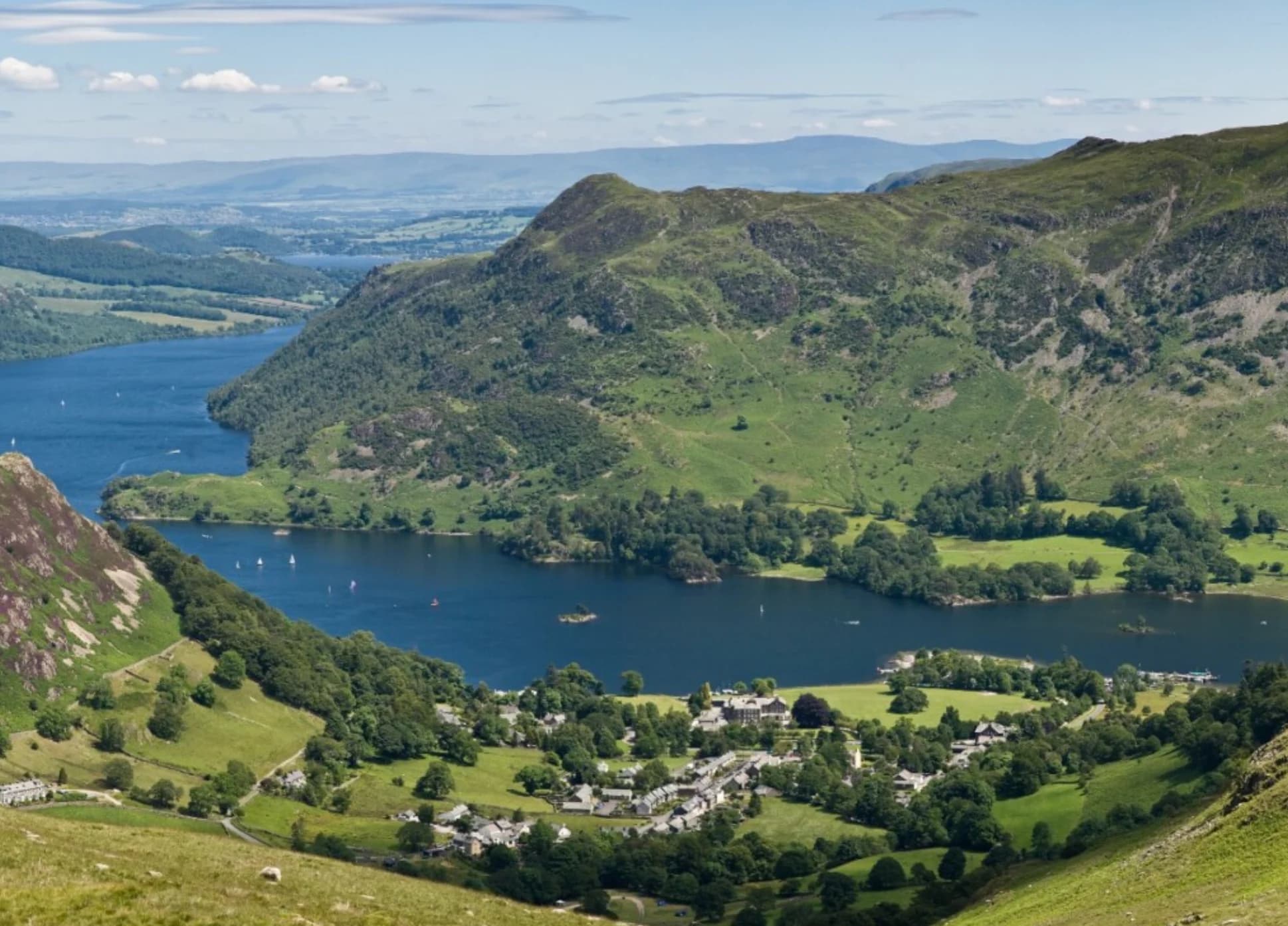
The northern reaches of the Lake District within Cumberland, centered on Keswick and the Borrowdale valley, offer some of England's most dramatic fell topography. Derwentwater sits in this zone, a lake whose proportions and light quality have made it a reference point for British landscape painting since the eighteenth century. Suites with fell or lake orientation in this area deliver a visual seriousness that is rare in English hospitality.
The Solway Coast
Less frequented than the lake valleys, the Solway Coast is a designated Area of Outstanding Natural Beauty stretching along Cumberland's western and northern edges. The mudflats, saltmarshes, and wide estuarine skies create a landscape of considerable austerity and calm. Boutique properties in this zone tend toward the understated, suited to travelers seeking genuine remoteness without sacrificing comfort.
Carlisle and the border country
Carlisle is Cumberland's only city, a place shaped by Roman fortification, Norman castle architecture, and centuries of Anglo-Scottish conflict. Its cathedral dates to the twelfth century. For the traveler interested in England's northern history, the city and its surrounding market towns provide a cultural density that is easy to underestimate. Luxury hotel suites in and around Carlisle increasingly occupy Georgian and Victorian buildings with proportions that modern architects rarely attempt.
The western coast and Ennerdale
The western coastal strip, running from Whitehaven south through St Bees, and the inland valley of Ennerdale represent Cumberland's least-visited luxury territory. Properties here operate on a smaller scale, often with a strong agricultural or estate identity. The absence of mass tourism is, for many guests, the point.
When to visit Cumberland for a luxury suite stay
Cumberland's climate is Atlantic, meaning mild winters, wet springs, and summers that can be warm without being predictable. The peak season runs from late May through early September, when fell walking conditions are at their most reliable and natural light extends well into the evening. Suite availability at top properties tightens significantly in July and August; booking three to six months in advance is standard practice for the best rooms.
Autumn, specifically late September through November, is increasingly favored by experienced travelers. The light across the fells and lakes in this period has a particular quality: low-angled, copper-toned, and dramatically atmospheric. Crowds thin, rates at some properties soften, and the landscape operates at what many consider its most photogenic register.
Winter in Cumberland is underappreciated. Fell country under frost or snow, with a well-appointed suite as a base, is a different proposition from a summer walking holiday. Several properties lean into winter comfort deliberately, with deep fireplaces, serious cellars, and the kind of interior programming that rewards staying in.
Spring is variable but can be exceptional. Late April and May bring the flowering of the valley floors and the return of extended daylight. Fell conditions remain unpredictable, but the relative quiet of the shoulder season makes it a sensible window for travelers who dislike competition for space.
Local luxury standards in Cumberland
England does not operate a formal national luxury classification equivalent to France's Palace designation. The Visit England grading system, which rates properties up to five stars, provides a baseline, but the most informative signals for suite quality in Cumberland come from independent recognition: AA Rosette ratings for dining, Relais and Chateaux membership, and inclusion in the Small Luxury Hotels of the World portfolio.
Country house hotels are the dominant format at the upper end of the Cumberland market. These properties typically occupy listed buildings, operate with a strong sense of place, and carry the kind of interior investment that reflects genuine ownership ambition rather than brand formula. Suite configurations here lean toward large bedrooms with separate sitting areas, freestanding bathtubs, and views framed by the original architecture of the building.
Farm and estate conversions are a second important category. These properties, often operating at a smaller scale, deliver an intimacy and a material authenticity that larger hotels cannot manufacture. For guests who value privacy and a reduced guest-to-staff ratio, this format deserves serious consideration.
How to choose the best luxury suite in Cumberland
The first consideration is orientation. In the Lake District portion of Cumberland, a suite with direct fell or lake views commands a significant experiential premium. Not all rooms marketed as lake-view deliver the same proximity or angle; the quality of the framing matters as much as the fact of the view.
Historical architecture versus contemporary fit-out is a real question in Cumberland. The county's finest buildings are largely Georgian, Victorian, or earlier. Properties that have restored rather than replaced original features, including cornicing, fireplaces, timber floors, and sash windows, tend to reward guests with a sensory coherence that modernized interiors lack.
Access to outdoor programming is a practical filter. Top Cumberland properties typically offer curated fell-walking guidance, private water access, and, in some cases, exclusive use of boats or estate land. Guests who will be using the landscape actively should confirm what the property includes versus what requires separate arrangement.
Suite size varies more than the category designation implies. In converted country houses, the largest suites are often former principal bedrooms with proportions that are genuinely architectural. These should be identified specifically at the time of inquiry rather than assumed from a room tier label.
Why a curated selection by La Suite matters in Cumberland
Cumberland's luxury hospitality market is not large. The number of properties genuinely operating at suite level, with the architecture, service, and investment that the category requires, is finite. The challenge for the discerning traveler is not discovery, it is discrimination: understanding which properties deliver on their positioning and which are well-photographed but operationally inconsistent.
La Suite applies a consistent editorial standard across every property in its selection. In Cumberland, that means identifying suites where the physical space, the landscape relationship, and the service model work as a coherent proposition. The curated selection by La Suite removes the research burden and replaces it with a set of verified options, each assessed against criteria that high-end travelers actually use to make decisions.