Where to stay in Northumberland: distinct areas and their character
The Northumberland coast
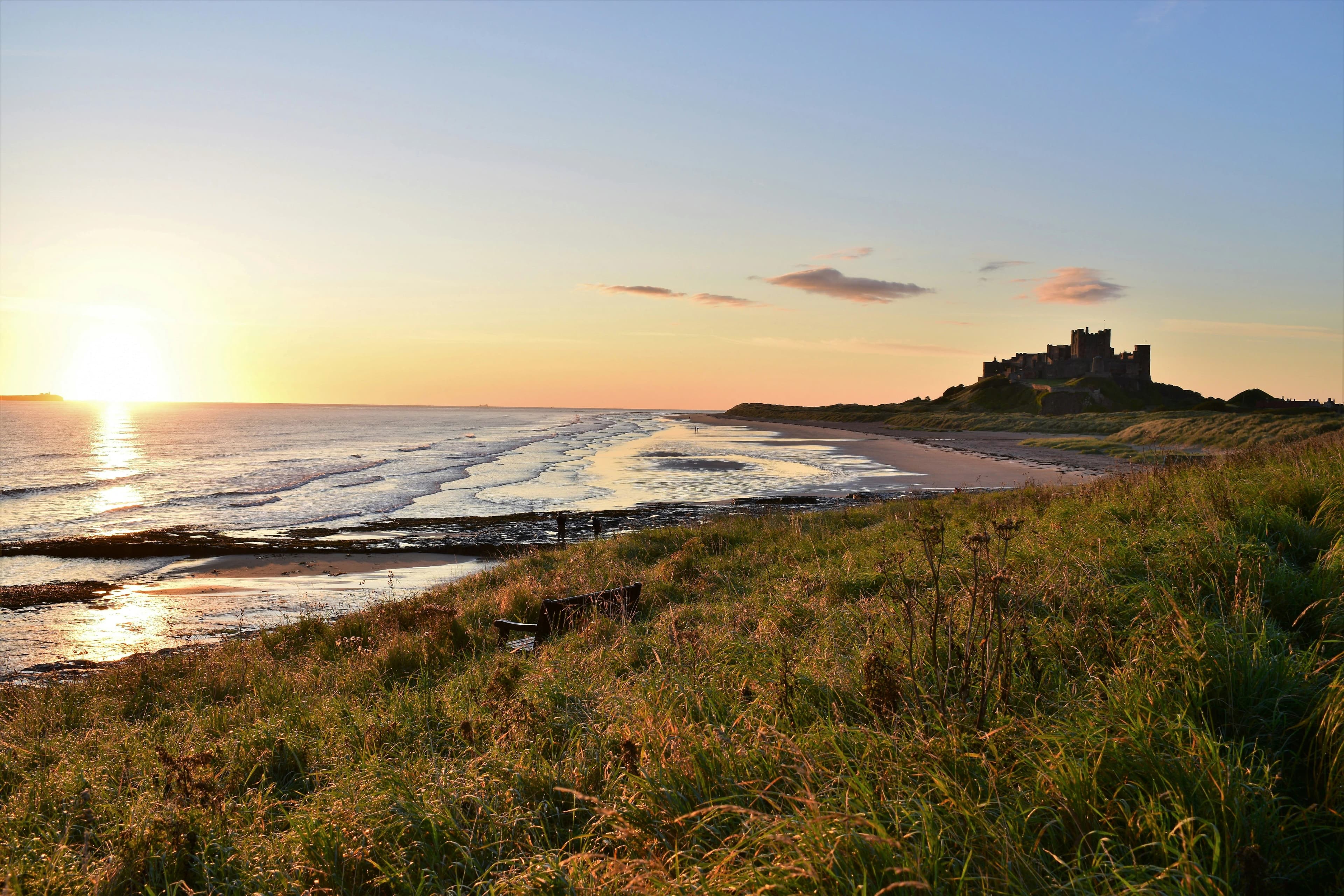
Stretching from Druridge Bay northward to Berwick-upon-Tweed, the Northumberland coast is classified as an Area of Outstanding Natural Beauty. Holy Island (Lindisfarne), accessible only by tidal causeway, and the Fame Islands, known for their grey seal and seabird colonies, anchor this stretch with genuine ecological weight. Properties near Bamburgh or Alnmouth position guests within reach of open dune landscapes and coastal walking that has no equivalent further south in England. A luxury hotel suite here typically offers direct or near-direct views across the North Sea, with the architectural sensibility informed by the exposed conditions of the site.
The Cheviot Hills and inland Northumberland
The Cheviot Hills form the spine of Northumberland National Park, one of the least visited national parks in England and among the darkest sky areas on the continent. The landscapes here are working agricultural land, wide and spare, with a visual grammar closer to the Scottish Borders than to the English Home Counties. Country house hotels and converted estate properties in this zone offer something specific: scale. Suites in this territory tend towards generous interior volume, period architecture, and grounds measured in hundreds of acres rather than manicured hectares.
The Tyne Valley and south Northumberland
Moving southward toward the River Tyne, the landscape becomes denser with heritage infrastructure: Hadrian's Wall runs east to west across this band of the county, and the market town of Hexham anchors the valley. Properties here serve as a base for both the Roman archaeology of the Wall and the cultural life of Newcastle-upon-Tyne, accessible in under an hour. The luxury hotel offering in this corridor is more varied in architectural scale, ranging from converted abbeys to Georgian estate houses.
When to visit Northumberland
The question of timing in Northumberland is closely tied to what the traveller is principally seeking.
Late spring (May to June) delivers the most reliable light and the lowest visitor density. The coast in particular is at its most photogenic, and the moorland transitions from winter brown to a textured green before the summer walking season fully arrives. Coastal suite availability is more flexible in this window than in high summer.
July and August represent peak domestic tourism, particularly along the coast. Bamburgh and Alnwick attract significant visitor numbers. Suite availability at preferred properties tightens, and advance planning of several months is standard for the better addresses.
September is broadly considered the optimal month by those who know the county well. Light quality shifts, the summer crowds recede, and the moorland begins its change toward the amber and rust tones that define the Northumberland autumn. Walking conditions are often ideal.
Winter visits, particularly December through February, require a specific appetite for solitude and weather. The county receives measurable snowfall in inland areas, and the coast in winter carries a particular drama. Properties that remain fully operational through winter often offer their most favourable suite rates in this window, and the dark sky quality for stargazing in the National Park is at its annual peak.
The Alnwick Garden is a significant cultural draw throughout the year, with its notable poison garden and large-scale treehouse structure. The Alnwick Food Festival in September attracts producers and visitors from across the north of England.
Understanding luxury standards in Northumberland
England does not operate the formal Palace hotel designation used in France. The relevant quality benchmark for the top tier of English hotel accommodation is the AA Five Red Star rating, awarded to fewer than thirty properties nationally. Several properties in or adjacent to Northumberland hold this rating or operate at an equivalent standard.
The category of country house hotel is the dominant form here, and it carries specific expectations: architectural heritage (frequently listed buildings of the 16th to 19th century), ground floor reception spaces of considerable volume, and suites that typically occupy corner or upper-floor positions in the main house. The conversion quality of period buildings varies considerably, and the distinction between a genuinely outstanding suite and a serviceable room presented as a suite is not always legible from standard listing platforms.
At the upper end, Northumberland suites in converted castles or estate houses may include private access to walled gardens, dedicated butler or house manager service, and the use of estate land for activities including shooting, fly fishing on private river beats, and guided walking. These are not amenities offered uniformly; they require specific enquiry and are better navigated through a curated platform than through general booking channels.
How to choose the right suite in Northumberland
Several practical considerations apply specifically to this region.
Architecture and history: the choice between a castle conversion, a Georgian manor, and a modern lodge property is substantive, not cosmetic. Each carries different interior acoustic and thermal qualities, different relationships to the landscape, and different service models. Defining this preference before searching saves considerable time.
Connectivity: Northumberland is large and relatively rural. The distance between a coastal property and an inland estate can exceed forty minutes by car. Itinerary design matters here. A suite positioned on the coast is not a convenient base for Hadrian's Wall, and vice versa.
Dog and family policy: many of the most desirable estate properties in Northumberland are explicitly dog-friendly and accommodate family parties in suite configurations. This is worth confirming at the point of enquiry rather than at arrival.
Seasons and access: tidal access to Holy Island has defined hours. Several walking routes and estate roads in the Cheviots are impassable in heavy snow. These are logistical realities that affect the planning of a stay, particularly in winter and early spring.
Why a curated selection by La Suite makes sense here
Northumberland's luxury hotel offer is not well indexed by standard travel platforms. The properties that perform best, in terms of suite quality, service depth, and genuine connection to the landscape, are frequently under-marketed. Some operate on a predominantly word-of-mouth basis. Others present their suites inconsistently across booking channels, making like-for-like comparison difficult.
La Suite maps this market with a specific brief: to identify the suites in Northumberland that deliver on the full proposition, space, architectural integrity, service, and location, and to present them with the precision a discerning traveller requires. The curated selection by La Suite removes the noise from a category where the noise is disproportionately high relative to the number of genuinely exceptional options.