

Gilles & Boissier / Design & Architecture: The Signature of Discreet Luxury
BY Jules Peulet

Gilles & Boissier embody a philosophy of space where restraint becomes strength, where every material speaks without shouting. Through three emblematic addresses, discover how this duo of architect-decorators redefines luxury hospitality through mineral subtlety and sculpted light.
Gilles & Boissier are not decorators who dress up space. They are architects who listen to it, breathe it in, and then reveal it through successive refinement. For more than three decades, the studio founded by Gilles Boissier and his team has imposed a visual grammar where material takes precedence over ornament, where geometry dialogues with natural light, where every detail obeys an implacable internal logic.
In a context of hyperconnectivity and aesthetic saturation, their approach to residential and hospitality luxury is directly aligned with the "quiet luxury" movement: one that does not shout its price, that refuses ostentatious display and privileges the silent excellence of architecture.
Discover all our other articles on leading architects in the hospitality sector !
Gilles & Boissier, a grammar of restraint: origins and influences of the studio
Gilles Boissier initially worked alongside great masters of French modernity. This lineage is not evident in a repetition of codes, but in a deep understanding of what habitable space is. For Gilles & Boissier, luxury rhymes with measure.
Their intellectual corpus is rooted in several founding convictions:
Material as protagonist: stone, wood, marble, polished concrete become characters. Each texture reveals its geographical origin and temporality.
Light not as an accessory but as a spatial architect: it sculpts volumes, accentuates transitions, creates imperceptible depths at first glance.
The erasure of decoration in favor of arrangement: furniture is never applied superficially; it integrates into the very structure of space.
A mineral color palette: beiges, nuanced grays, broken whites, powdered ochres. No color to seduce; a tonality to breathe.
This philosophy flourishes fully when it meets the context of major hotel commissions. The challenge then becomes to elevate the guest experience not through an accumulation of services, but through the almost imperceptible quality of the environment. A suite signed by Gilles & Boissier envelops you without suffocating you.
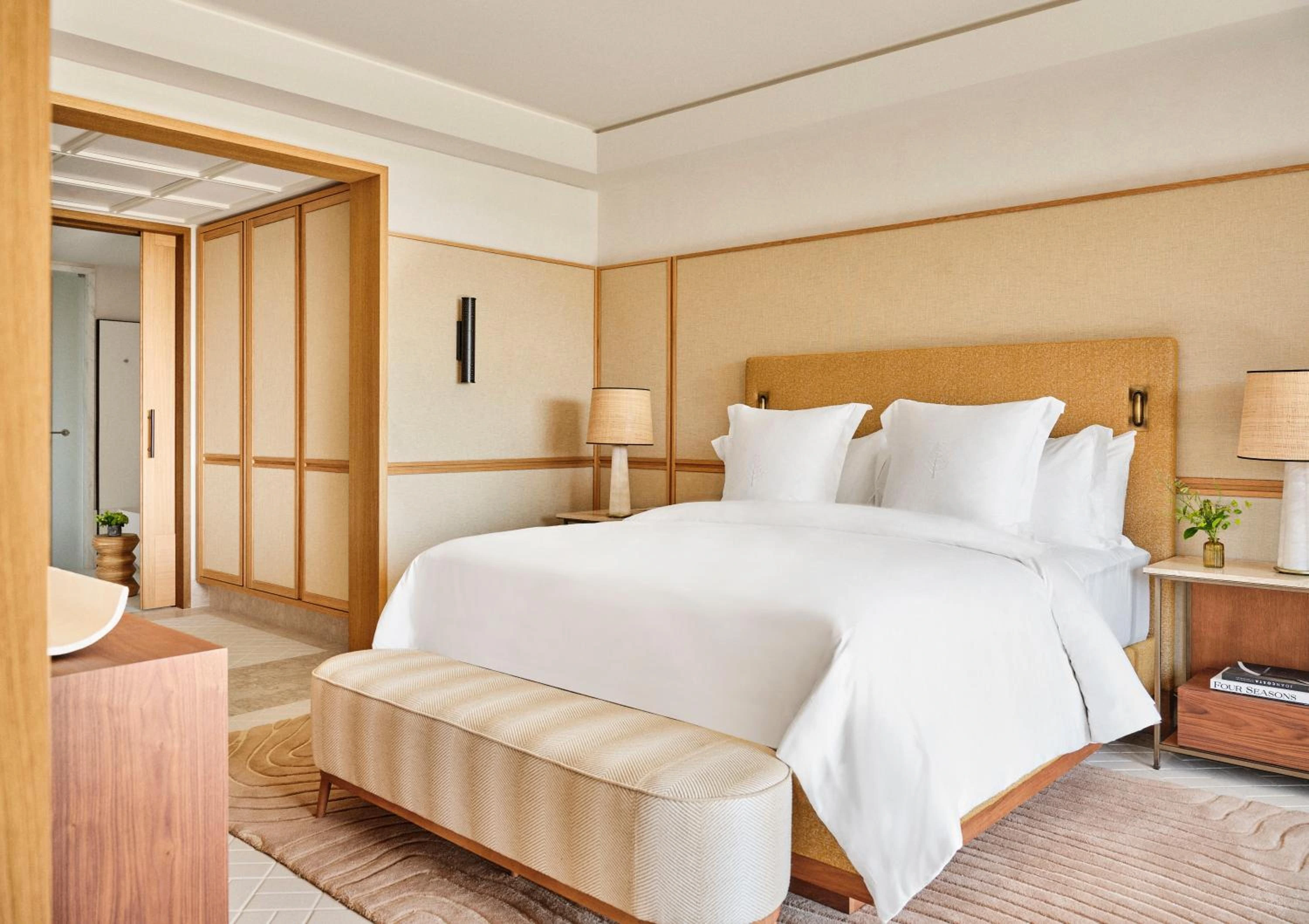
Four Seasons Resort Mallorca at Formentor: dialogue between Mediterranean stone and horizon
The Four Seasons Resort Mallorca at Formentor embodies the studio's ability to dialogue with a place of pronounced character: the Formentor peninsula, its limestone cliffs, its vertebral Mediterranean light.
Gilles & Boissier did not impose a style. They listened. The local stone, the very same that constitutes the resort's walls, becomes a material for interior narration. In each suite, notably the Pine View Suite, the finishes embrace the natural hues of the terroir: pale ochre, blue-grey, whitewashed white. Nothing artificial, everything continuity.
The Grand Pine View Suite with Plunge Pool, particularly, offers a spatial experience where the interior extends outdoors without harsh interruption. Terraces are treated as extensions of the interior; the personal pool integrates into the architecture as a natural geometric element. The palette remains mineral: light concrete, blonde wood, refined furniture in simple geometric forms.
Light plays a structural role here. It does not penetrate the suite; it constructs it. The play of shadows generated by the awnings and soft wood screens create a succession of graduated luminous zones, inviting the eye to progress gradually toward the horizon. This staging of clarity is one of the duo's major signatures.
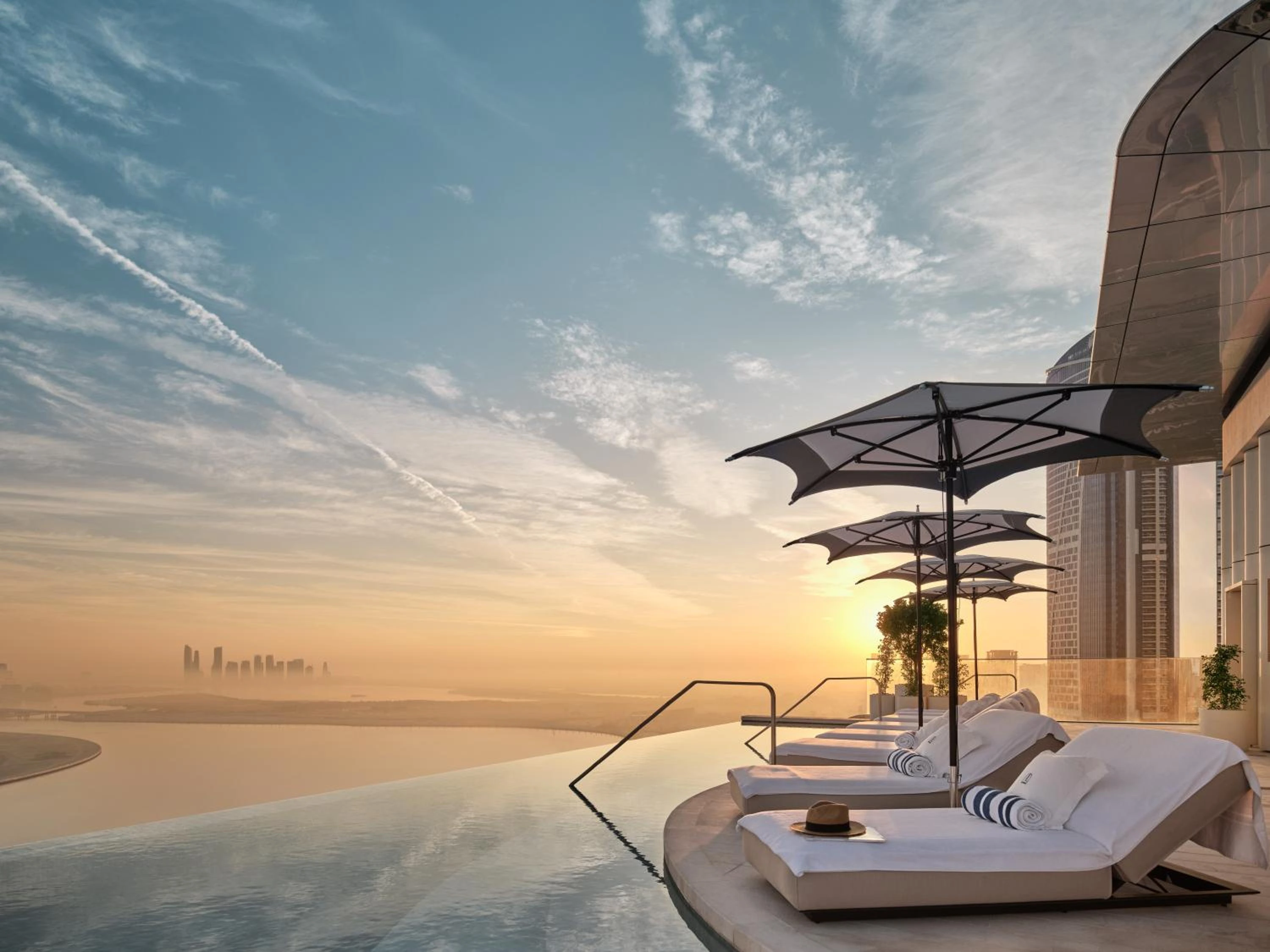
The Lana, Dorchester Collection: verticality and noble materials in the heart of Dubai
Dubai exerts a permanent temptation toward excess. Gilles & Boissier's approach at the The Lana, Dorchester Collection was diametrically opposed: to build a sanctuary of radical austerity in the heart of urban hyperconsumption.
The establishment, whose ribbed verticality structures the experience, distinguishes itself through interior architecture that refuses superfluity. The Suite Marina Sky (110 m²) illustrates this philosophy: walls in off-white marble, flooring in natural stone with subtle veining, whitewashed oak woodwork that evokes Scandinavian asceticism. Urban panoramas become the decoration; the interior does not attempt to compete with the city, but rather to transform it into a controlled spectacle.
In the Marina Suite with Terrace (221 m²), this contrast becomes radical. Dubai's vast exterior, with its mirror towers and captive waters, dialogues with an interior of exemplary restraint. Gilles & Boissier have proposed an extremely tight chromatic reading: white, beige, pearl grey. No dramatic contrast, but an almost somnambulistic harmony that allows the body to unwind.
Materials here signify an absence of compromise. Marble is never too bright (matte finish); wood breathes its veins without visual overload; polished concrete embodies modernity without coldness. This restraint in the face of surrounding extravagance constitutes the strongest form of luxury in Dubai: one that says "I have nothing to prove".
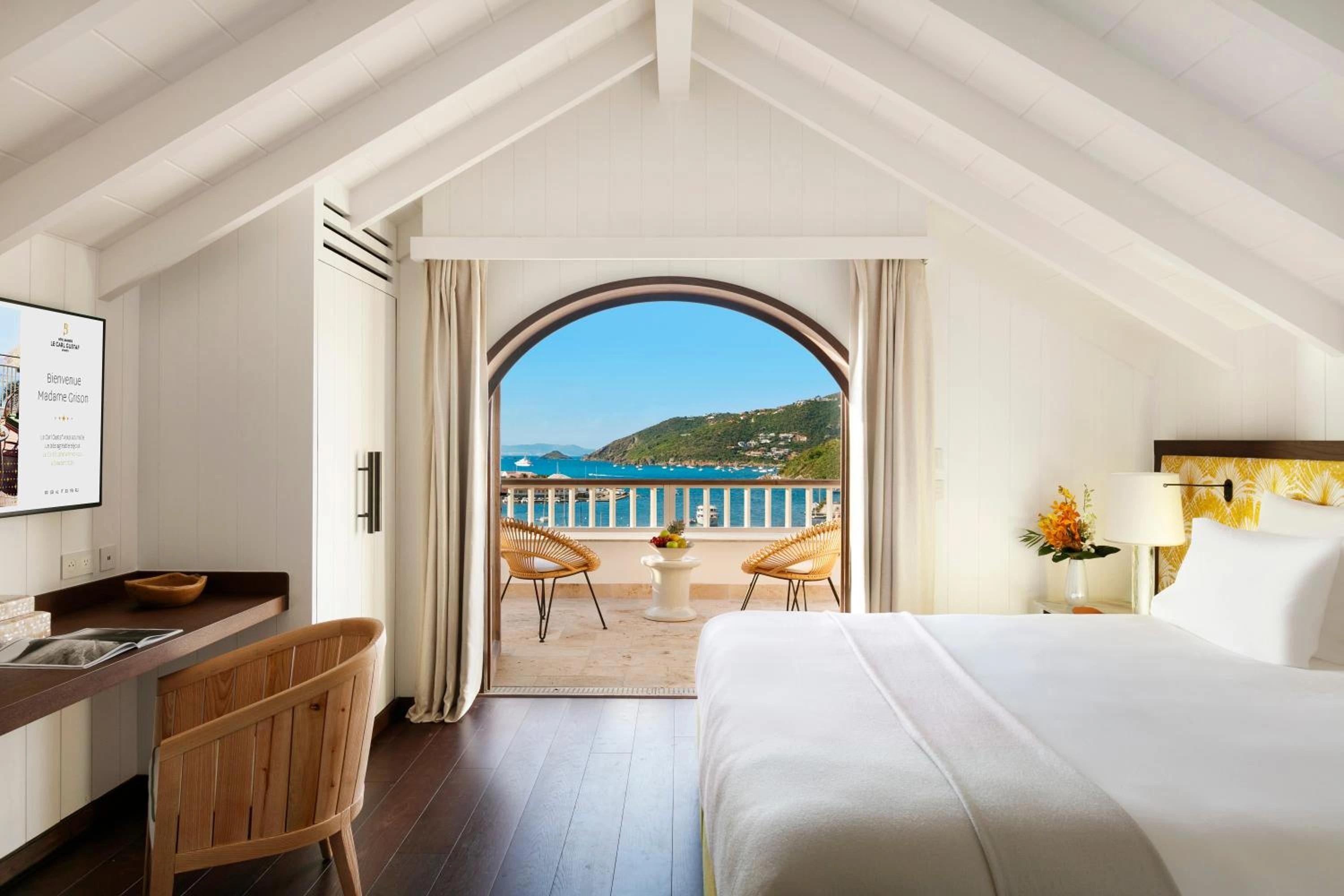
Fouquet's Saint-Barth: uninhibited elegance under the tropics
Saint-Barthélemy calls for a certain lightness, a permeability to the elements. Fouquet's Saint-Barth responds to this imperative with a tropical but never exotic signature. Gilles & Boissier managed to marry the chic Parisian DNA of the Fouquet's house with the salty air of the Caribbean.
The Prestige Suite 2 Bedrooms with Pool - Sea View (70 m²) does not forgo noble materials, but translates them differently. Rather than solid marble, it is a porous limestone, veined with pale pink. Rather than raw, heavy wood, it is bleached teak, light, breathing. The tones adjust: beiges of extreme fineness, whites slightly tinged with coral pink, greys almost lavender under the influence of the sea.
The Sugar Loaf Suite with Infinity Pool embodies a tropical refinement where architecture becomes invisible. Glass walls merge interior and exterior; the infinity pool offers virtual continuity with the ocean horizon. It is an act of architecture: one did not see these transitions; now that they are there, they seem inevitable.
Here, tropical light behaves differently than in Majorca or Dubai. It is more violent, more direct. Gilles & Boissier master it through wooden shutter systems that fragment the rays without interrupting the view. The interstices of light then play the role of a draftsman, tracing ephemeral lines on floors and walls.
What distinguishes a suite signed by Gilles & Boissier: critical reading of codes
Three traits structure the studio's approach to hotel commissions:
1. The abolition of the surprise effect
Unlike many contemporary designers who cultivate visual shock, Gilles & Boissier favor the effect of progressive revelation. One enters a suite; one sees nothing extravagant. Then, after a few minutes, one realizes that one is enveloped in silent perfection. This deliberate absence of initial impact is a mark of modern luxury.
2. Color palette as geographic narrative
Each destination generates its own colored grammar. The Mediterranean does not demand the same hues as the Persian Gulf or the Caribbean. Gilles & Boissier listens to each geography and extracts a mineral essence from it that makes sense. It is the work of a visual archaeologist rather than a decorator.
3. The integration of furniture into architecture
Gilles & Boissier suites never appear furnished. Pieces are part of the construction of space, not its ornament. A bed is not an object placed; it is an architectural structure integrated into the volume. This fusion erases the boundary between interior design and architecture, which was the original definition of the craft.
4. Material as a vehicle for authenticity
No artificial finishes masking constructive reality. Marble displays its veins; wood reveals its grain; concrete assumes its minerality. This material honesty transmits to the guest a sensation of solidity, of truth, which calms the soul far more than an accumulation of superficial services.
The influence of Gilles & Boissier on the redefinition of hotel luxury
Today, as monolithic luxury collapses, the architectural language of the Gilles & Boissier studio is establishing itself as a paradigm. The high-end hotel market is progressively recognizing that seducing through excess is no longer a viable strategy. What works is learned architecture, authentic material, considered light, restrained color.
The three addresses explored here are not design museums; they are living spaces where the body feels welcomed by a spatial logic that functions effortlessly, without theatricality. This is quiet luxury: the kind one only notices when it disappears, so natural did it seem.
Key takeaways
Gilles & Boissier apply a resolutely mineral architectural grammar, where matter, light and geometry take precedence over ornament.
Each suite reflects the geographical essence of its destination: Mediterranean stone in Majorca, urban minimalism in Dubai, tropical lightness in Saint-Barth.
The studio grounds luxury in the absence of display: a perfection so natural that it becomes invisible, defining contemporary "quiet luxury".
The integration of furniture into architecture transforms each suite into an inhabited structure rather than an adorned space, abolishing the boundary between design and architecture.
Explore other approaches to contemporary hotel architecture through our portraits of Jean-Michel Wilmotte or the masters of residential minimalism with Festen Architecture.
Frequently Asked Questions
What characterizes Gilles & Boissier's architectural style?
Gilles & Boissier favor a minimalist approach founded on the progressive refinement of space. Their projects are defined by the use of authentic materials (marble, wood, concrete), a soft and nuanced color palette, as well as a mastery of natural light. Far from the spectacular, their signature lies in silent perfection and the harmonious integration of furniture into architecture.
Where can you find suites designed by Gilles & Boissier?
The three major addresses presented in this article are the Four Seasons Resort Mallorca at Formentor in Spain, The Lana, Dorchester Collection in Dubai, and Fouquet's Saint-Barth in the Caribbean. Each of these establishments embodies a different interpretation of their architectural language.
What is meant by "quiet luxury" in hotel architecture?
Quiet luxury refers to a form of discreet luxury that refuses ostentation. In architecture, this means privileging the intrinsic quality of materials, the geometric exactness of proportions, and functional excellence over any dramatic effect or visual overload. Gilles & Boissier are its contemporary masters.
How does a mineral color palette influence the guest experience?
A mineral palette (nuanced beiges, subtle grays, broken whites) creates a restful visual environment that soothes the nervous system. Unlike saturated colors, it allows the guest to breathe, relax, and apprehend space without sensory saturation. It is a deliberate choice in favor of physical and psychological well-being.
What is the difference between interior design and interior architecture at Gilles & Boissier?
Gilles & Boissier abolish this distinction. Their suites are never decorated in the traditional sense; they are architecturally conceived. Furniture, finishes, lighting are not added to the structure; they constitute its internal logic. It is a return to the original definition of the architect-decorator's craft: one who thinks the space in its entirety.
More from the Journal

Perth and Broome, Mapping Coastal Luxury in the West
Australia's western coast remains a discreet territory for luxury hospitality. Between the mineral verticality of Perth and the colonial elegance of Broome, four exceptional addresses reveal how contemporary architecture dialogues with raw materials, the harsh desert light, and the infinite horizons of the Indian Ocean.
BY Jules Peulet

New Zealand / Design & Architecture: suites where architecture dialogues with landscape
In New Zealand, hotel architecture reinvents itself through a radical vision: the suite becomes an instrument for observing the great southern landscape. From raw wood to mineral facades, discover how four exemplary establishments create a dialogue between interior space and the volcanoes, lakes and mountains of the South Island.
BY Jules Peulet

Megève / Design & Architecture: Wood and Stone as the Signature of Luxury Suites
In Megève, four prestigious establishments redefine the language of the contemporary chalet by making raw materials their signature. Larch, local stone and refined linen become the protagonists of an architecture where each texture tells the story of the mountain.
BY Jules Peulet