
Jean-Michel Wilmotte: The Architect Reinventing Luxury Heritage Hotels
BY Jules Peulet

The era when luxury hospitality was content to reproduce period décors has ended. Today, the international elite no longer seeks to sleep in a frozen museum, but to inhabit history with absolute comfort. As we emphasized in our manifesto Masters of Space: Who Designs Tomorrow's Suites, the architect's name is now the first criterion of the travel experience. In this quest for perfection, one undisputed master reigns over the art of marrying past and future: Jean-Michel Wilmotte. From the monumental renaissance of Hôtel Lutetia in Paris to the refined shores of the Mediterranean, immerse yourself in the world of a visionary who sculpts light, marble and silence to create the most majestic sanctuaries of our time.
1. Jean-Michel Wilmotte: The Master of "Contemporary Grafting"
To understand a suite designed by Jean-Michel Wilmotte, one must first understand the man and his philosophy. A world-renowned French architect, urban planner and designer, Wilmotte founded his agency in 1975. For nearly fifty years, he has worked on titanic projects: from the Louvre Museum to the Rijksmuseum in Amsterdam, passing through the urban furniture of the Champs-Élysées.
In luxury hospitality, Wilmotte has established himself through a concept he has mastered to perfection: "contemporary grafting". When he tackles a historic building (an Art Deco palace, an old monastery or a Provençal building), his goal is never to create pastiche or copy the old. He cleans the structure to recover the building's original framework, then he inserts ("grafts") elements of absolute modernity, with pure, taut and geometric lines.
This approach creates a fascinating architectural tension. The traveler instantly feels the weight of history and the nobility of heritage, while enjoying the ergonomics, clarity and perfect acoustic insulation of the 21st century. With Wilmotte, luxury is never loud or ostentatious; it is structural, anchored in design intelligence and the perfect proportion of volumes.
2. The "Wilmotte Code": Material, Light and Acoustics
At La Suite, we analyze hotels beyond their simple aesthetic appearance. Jean-Michel Wilmotte's work is distinguished by a scientific approach to comfort that can be summed up in three fundamental pillars.
The Truth of Material (Mineral and Wood)
In a bedroom or bathroom signed by Wilmotte, you will find no synthetic materials. He is the sculptor of mineral. His spaces integrate monolithic blocks of Statuario marble, blue Macauba marble or dressed stone, which he contrasts with warm and luxurious wood essences such as eucalyptus, smoked oak or walnut. The integration of bronze and dark metals emphasizes the edges of the space, offering a clear and legible reading of it.
The Quest for Natural Light
Wilmotte is obsessed with light. In historic buildings, often dark, his first instinct as an architect is to dig. He opens patios, pierces skylights and uses tinted mirrors to circulate natural sunlight to the heart of the suite. This light engineering combats jet lag stress and restores to the traveler a perfect notion of the passage of time.
The Engineering of Silence (Acoustics)
It is often the best-kept secret of his hotel projects. Wilmotte integrates acoustic insulation directly into the DNA of the building. The thickness of doors, the use of invisible acoustic plaster and the density of floors create environments of monastic calm. It is the ultimate luxury: to find yourself in the center of a bustling metropolis and hear, once the suite door is closed, nothing but absolute silence.
3. The Portfolio: Wilmotte's Iconic Suites and Hotels
To grasp the full scope of Jean-Michel Wilmotte's talent, you must physically inhabit his spaces. The agency has signed some of the world's most prestigious properties. Here is our La Suite selection of architectural gems where his genius expresses itself fully.
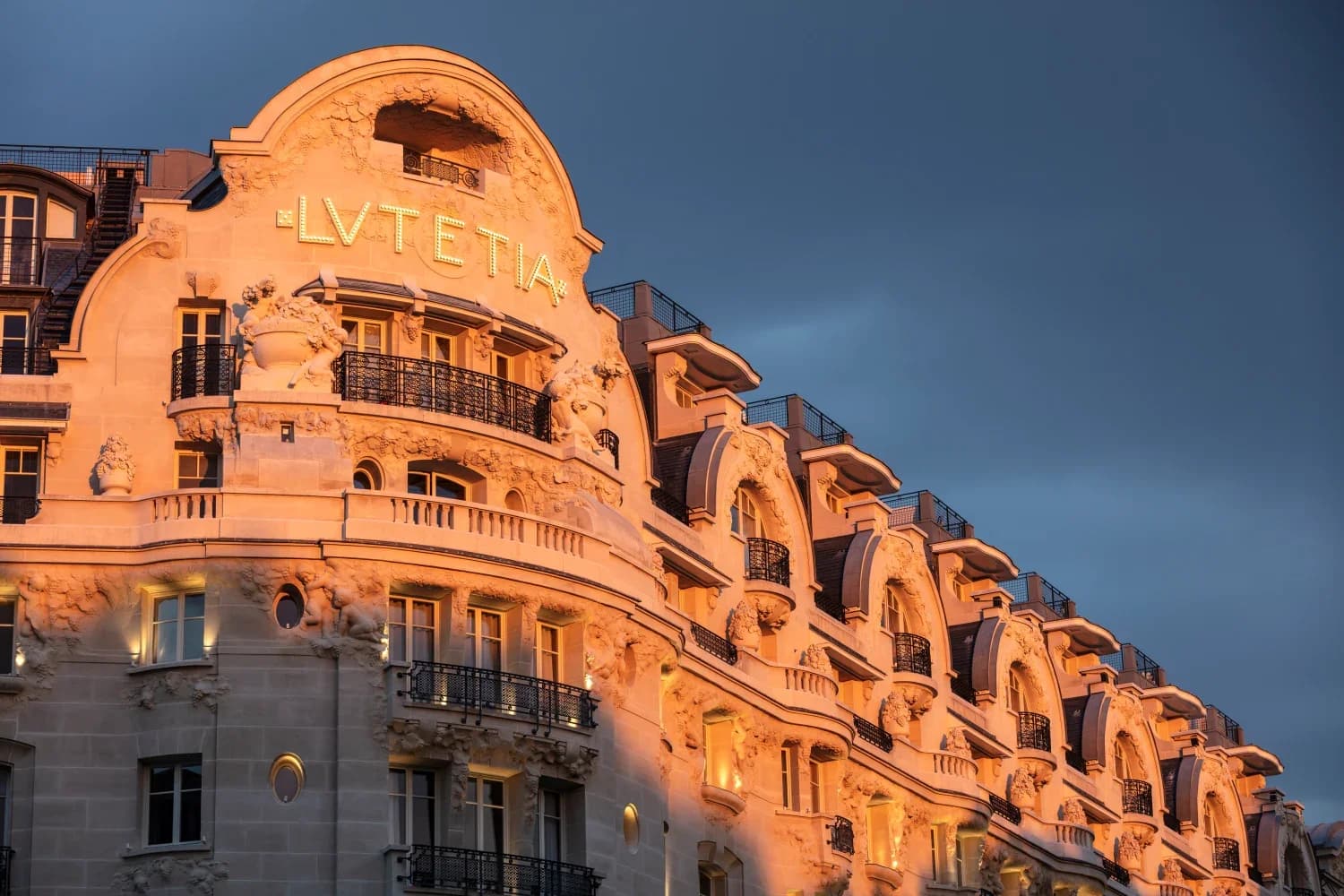
Lutetia Hotel, Paris: The Renaissance of a Left Bank Legend
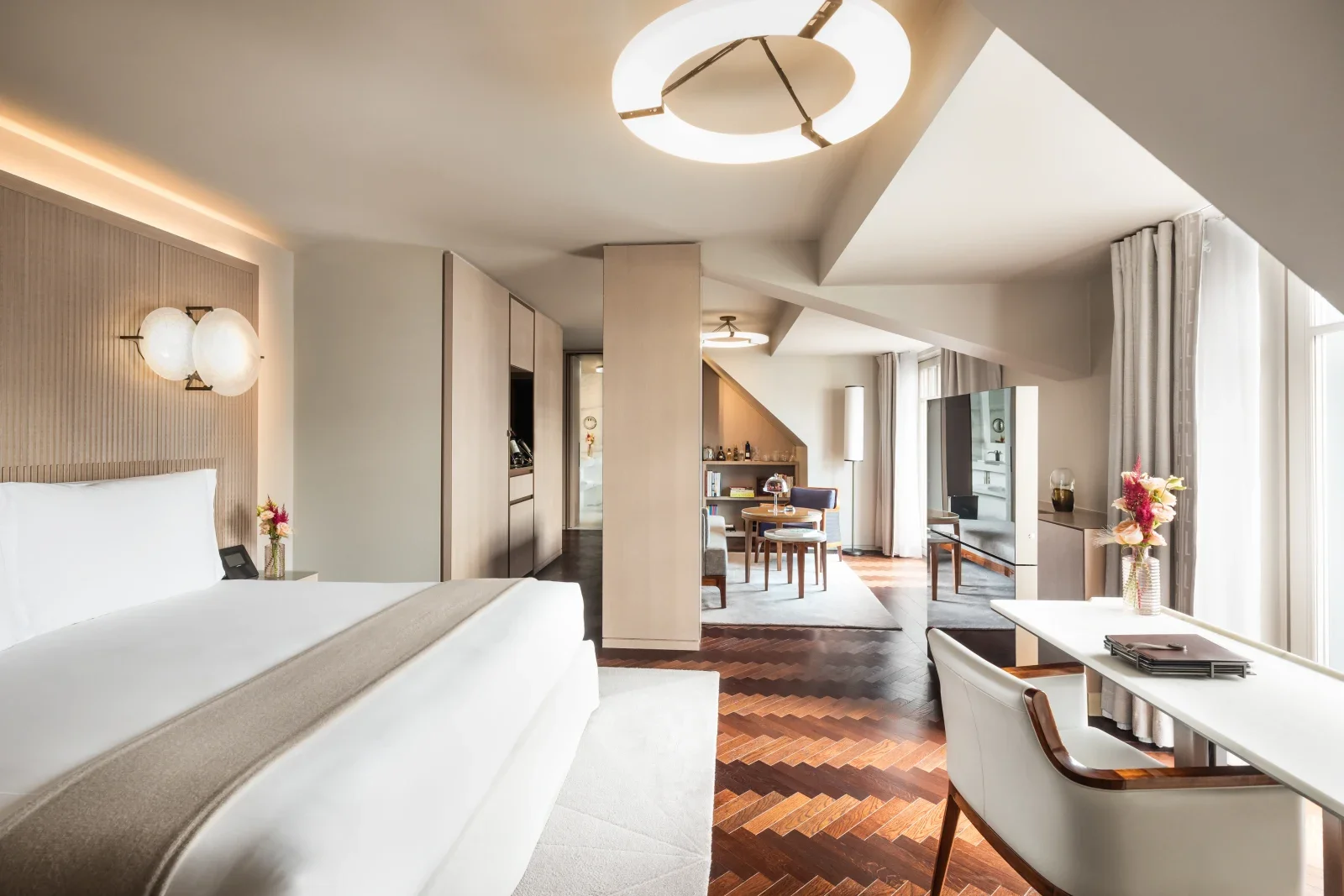
It is arguably the architect's masterpiece in hospitality. The only great palace on Paris's Left Bank, the Lutetia had lost its lustre under layers of successive renovations. Wilmotte undertook a titanic project there for four years. He excavated an interior courtyard to flood the hotel with light and restored the Art Deco and Art Nouveau frescoes with archaeological precision. The rooms and suites of the Lutetia are the perfect expression of his style. Polished eucalyptus doors, custom-made furniture with nautical lines, dressing rooms integrated like haute couture boutiques and enormous bathrooms carved from entire blocks of white marble create a sense of sovereign purity. Immense bay windows flood the space with brilliant light.
For whom? The demanding business traveler, Art Deco enthusiasts and those seeking the quintessence of Parisian intellectual chic.
Cheval Blanc St-Tropez: LVMH's Mediterranean Refuge
Formerly "La Résidence de la Pinède", this legendary establishment purchased by the LVMH group was completely reimagined by Jean-Michel Wilmotte to become Cheval Blanc St-Tropez. The challenge was considerable: how to create a palace on the Côte d'Azur without falling into "bling-bling"? The architect's answer was absolute Mediterranean simplicity. Using a color palette inspired directly by the landscape (the intense blue of the sea, the white of the sand and the warm color of parasol pine trunks), Wilmotte created suites that open completely to the outside. The use of blonde wood, local ceramics and flowing lines gives these spaces incredible airiness, firmly anchoring the property in the timeless elegance of the Riviera.
For whom? Aesthetes seeking confidential, sun-filled and exclusive luxury on the Côte d'Azur.
La Réserve Ramatuelle: Integration with Nature
High above the Mediterranean, far from the bustle of Tropez, La Réserve Ramatuelle is a manifesto of integration architecture. Rather than constructing an imposing building, Jean-Michel Wilmotte imagined a hotel that hugs the ridgeline and nearly disappears into the scrubland. The suites are a model of warm minimalism. They offer spectacular volumes, accentuated by light stone flooring, raw linen, and immense terraces that extend the bedroom toward the sea. Architecture effaces itself entirely to give center stage to the natural panorama. It is a space conceived to calm the mind and foster profound contemplation.
For whom? Travelers seeking spiritual retreat, detoxification, and uninterrupted panoramic views.
Le Bellune, Paris: Urban and Industrial Chic
Proof that the architect also knows how to adapt to contemporary urban hospitality, Le Bellune, located in the highly visible 15th arrondissement of Paris, reflects a more industrial and warm aesthetic. Drawing inspiration from brutalist architecture while softening it with noble materials, Wilmotte designed living spaces where wood, exposed concrete, and metal meet. The suites are optimized, functional, while offering a very Parisian protective atmosphere, conceived for the modern traveler, hyper-connected yet seeking decompression.
For whom? Entrepreneurs, premium digital nomads, and urban design enthusiasts.
Ready to inhabit these masterpieces? Browse our rigorous curations and book your next exceptional suite in Paris, in the heart of London, or facing the Mediterranean on the French Riviera.
4. Why Choose a Suite Signed by Jean-Michel Wilmotte? (La Suite's View)
As curators of hotel excellence, we know that the physical environment conditions mental performance and physical well-being.
You should choose a suite signed by Jean-Michel Wilmotte if you need clarity, order, and silence. His spaces are not overloaded with unnecessary decoration; they provide a clean "mental canvas." The rigor of his geometric lines, the absence of garish colors, and the reassuring weight of noble materials (marble, solid wood, bronze) act as stabilizers for the nervous system.
For an industry leader on the move, a writer seeking focus, or simply a traveler escaping urban chaos, Wilmotte's architecture offers absolute sanctuary. It is not merely a luxury hotel; it is a masterpiece of ergonomics and peace designed by one of France's greatest builders.
Continue Your Architectural Immersion
To extend your immersion in the world of hotel design, we invite you to discover the other signatures redefining the art of contemporary living. Explore theatrical maximalism through our analysis of Hugo Toro, or immerse yourself in the residential elegance and "quiet luxury" of the Festen studio. For a comprehensive vision of space masters, explore our manifesto dedicated to the new architects of luxury.
If you wish to understand the invisible engineering of these sanctuaries, our clinical studies dedicated to the psychology of materials and to the aesthetic movements of tomorrow will provide you with the visual and tactile grammar of the most demanding travelers.
5. Frequently Asked Questions (FAQ)
1. How would you define Jean-Michel Wilmotte's architectural style in hospitality?
Wilmotte's style is characterized by "contemporary grafting." He meticulously respects the volumes and history of classical buildings, yet inserts elements of refined, geometric modernity. His hallmarks are the use of noble materials (marble, bronze, oak), an obsession with the entry of natural light, and finishes of absolute rigor.
2. What is Jean-Michel Wilmotte's most emblematic hotel project?
The renovation of the Hôtel Lutetia in Paris is arguably his most monumental hotel project. He breathed new life into Paris's sole Left Bank palace by creating an interior courtyard to flood the building with light, while reinventing the suites with a design blending contemporary clarity with Art Deco references.
3. Are Wilmotte-designed hotels cold or minimalist?
Although minimalist and highly refined, Wilmotte's architecture is never "cold". He avoids this pitfall by using what is called "the truth of materials". He warms spaces with smoked wood flooring, very soft lighting and textured fabrics of superior quality. His suites offer a sense of security and monastic warmth.
4. Does Jean-Michel Wilmotte also create hotels with a Mediterranean atmosphere?
Absolutely. His masterly work on the Cheval Blanc St-Tropez and La Réserve Ramatuelle proves his versatility. For these projects, he moves away from Parisian architecture toward more horizontal lines, sand colors, light woods (pine) and tremendous permeability between the suite's interior and the sea view.
5. Why book through La Suite to reserve a Wilmotte-designed room?
Not every suite within the same hotel benefits from the same exposure or layout. By going through La Suite, you benefit from our clinical expertise in design. If you are specifically seeking a room with monumental ceiling height or a bathroom in Macauba blue marble at the Lutetia, our concierge chat is at your disposal to guide you toward the ideal reservation.
More from the Journal

Perth and Broome, Mapping Coastal Luxury in the West
Australia's western coast remains a discreet territory for luxury hospitality. Between the mineral verticality of Perth and the colonial elegance of Broome, four exceptional addresses reveal how contemporary architecture dialogues with raw materials, the harsh desert light, and the infinite horizons of the Indian Ocean.
BY Jules Peulet

New Zealand / Design & Architecture: suites where architecture dialogues with landscape
In New Zealand, hotel architecture reinvents itself through a radical vision: the suite becomes an instrument for observing the great southern landscape. From raw wood to mineral facades, discover how four exemplary establishments create a dialogue between interior space and the volcanoes, lakes and mountains of the South Island.
BY Jules Peulet

Megève / Design & Architecture: Wood and Stone as the Signature of Luxury Suites
In Megève, four prestigious establishments redefine the language of the contemporary chalet by making raw materials their signature. Larch, local stone and refined linen become the protagonists of an architecture where each texture tells the story of the mountain.
BY Jules Peulet