

Mexico: Architect-Designed Luxury That Redefines the Suite
BY Jules Peulet

Between raw concrete, volcanic stone, and total openings onto the landscape, Mexico establishes itself as one of the most fertile territories for contemporary hotel architecture. From Riviera Nayarit to Mexico City, passing through Tulum and Puerto Escondido, a new generation of properties reinvents the vocabulary of the luxury suite. Material, light, and landscape dictate the space, never the reverse.
The Mexico is no longer simply a beachside destination. Over the past decade, it has become one of the world's most demanding laboratories for architectural hospitality. A select number of establishments there practice a luxury founded on formal radicality: materials extracted from the local soil, volumes designed to dialogue with vegetation or the ocean, and suites where every detail expresses a designer's intent.
These addresses do not seek to impress through accumulation. They convince through the precision of their architectural language, through the quality of the silence they create, and through the way they bring the territory into the room.
Mexico, an architectural laboratory for contemporary hospitality
The country possesses an exceptional material: its geography. Dense jungle, coral reef, wild Pacific coast, stratified urban center. Each environment calls for a distinct architectural response. The most relevant hotels understood this and did not seek to standardize their aesthetic.
Local volcanic stone, polished concrete, dark wood from tropical species, lime-tinted stucco: these materials now constitute the grammar of an identifiable Mexican luxury. A luxury that turns its back on colonial pastiche to fully embrace the contemporaneity of its forms.
This movement goes beyond decoration. It touches the very structure of space: how a wall opens onto the canopy, how a pool merges into the horizon line, how a terrace becomes the true center of life in a suite. To explore further this question of hierarchy between architect and decorator in suite design, our analysis Architect vs Decorator: Who Truly Structures Your Suite's Space? offers precise insight.
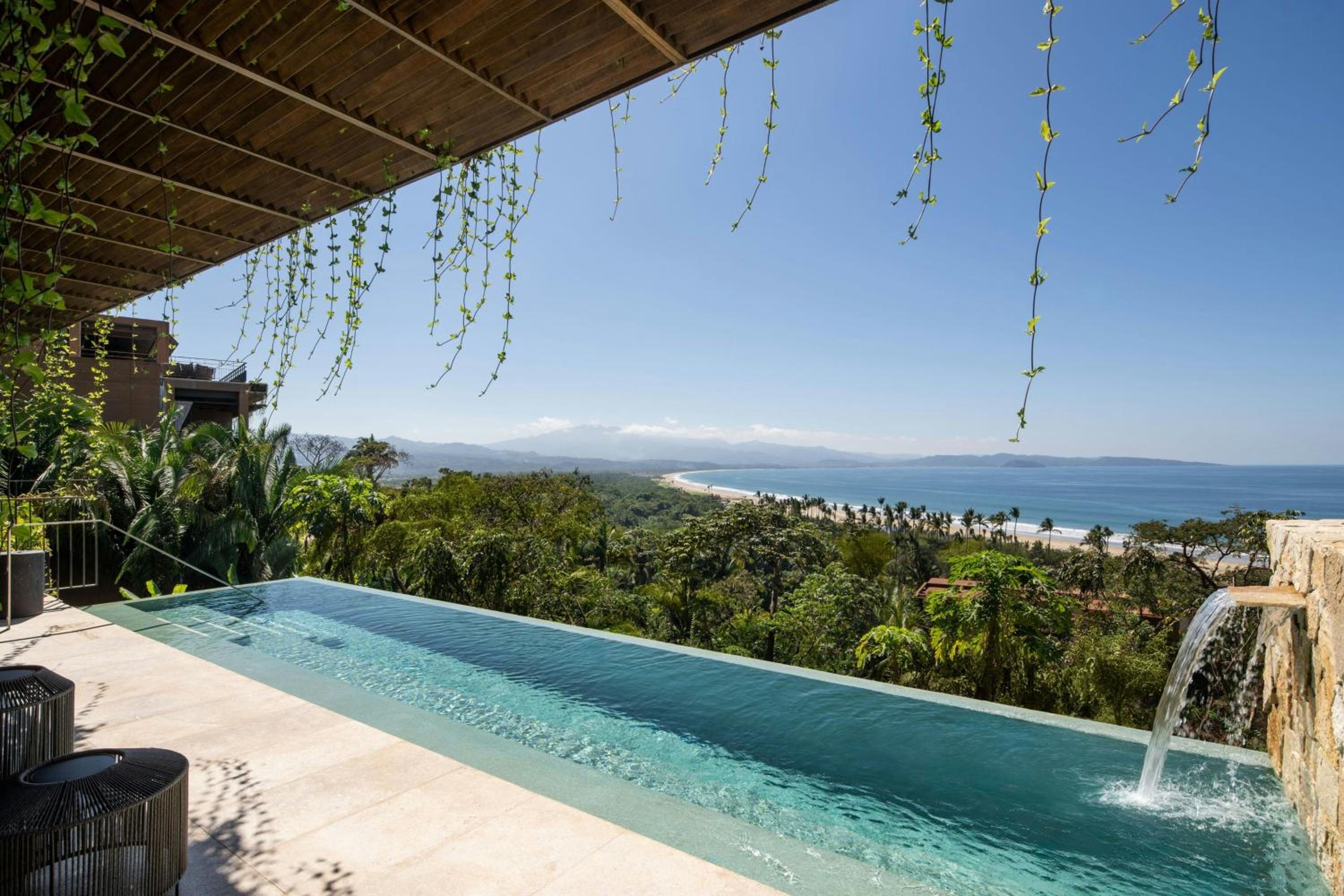
Siari Riviera Nayarit, a Ritz-Carlton Reserve: the Ritz-Carlton Reserve signature in the jungle
In the Compostela region, in the heart of the Riviera Nayarit, the Siari Riviera Nayarit, a Ritz-Carlton Reserve represents the Ritz-Carlton group's entry into its collection of the world's rarest addresses. The Reserve designation indicates a precise philosophy: fewer rooms, more space, total integration with the site.
Siari's architecture revolves around the relationship between primary vegetation and constructed volumes. The structures appear placed with restraint in the jungle, leaving the trees to frame the views. The garden, private beach, and terrace are not added amenities: they are the foundations of the project.
Suites designed as pavilions
The Beach Front Pool King Suite with Sofa Bed (108 m²) positions the stay facing the Pacific, with private pool and direct beach access. The pool water, the ocean water: two planes that visually overlap from the bed, creating a depth of field that only open-air architecture allows.
The Panoramic View Pool King Suite with Sofa Bed, also 108 m², chooses elevation over proximity. It embraces a panorama that encompasses both the jungle and the marine horizon, from a slightly elevated position. The private pool here functions as an additional frame, a liquid window onto the landscape.
LaSuite Selection: Siari Riviera Nayarit, a Ritz-Carlton Reserve
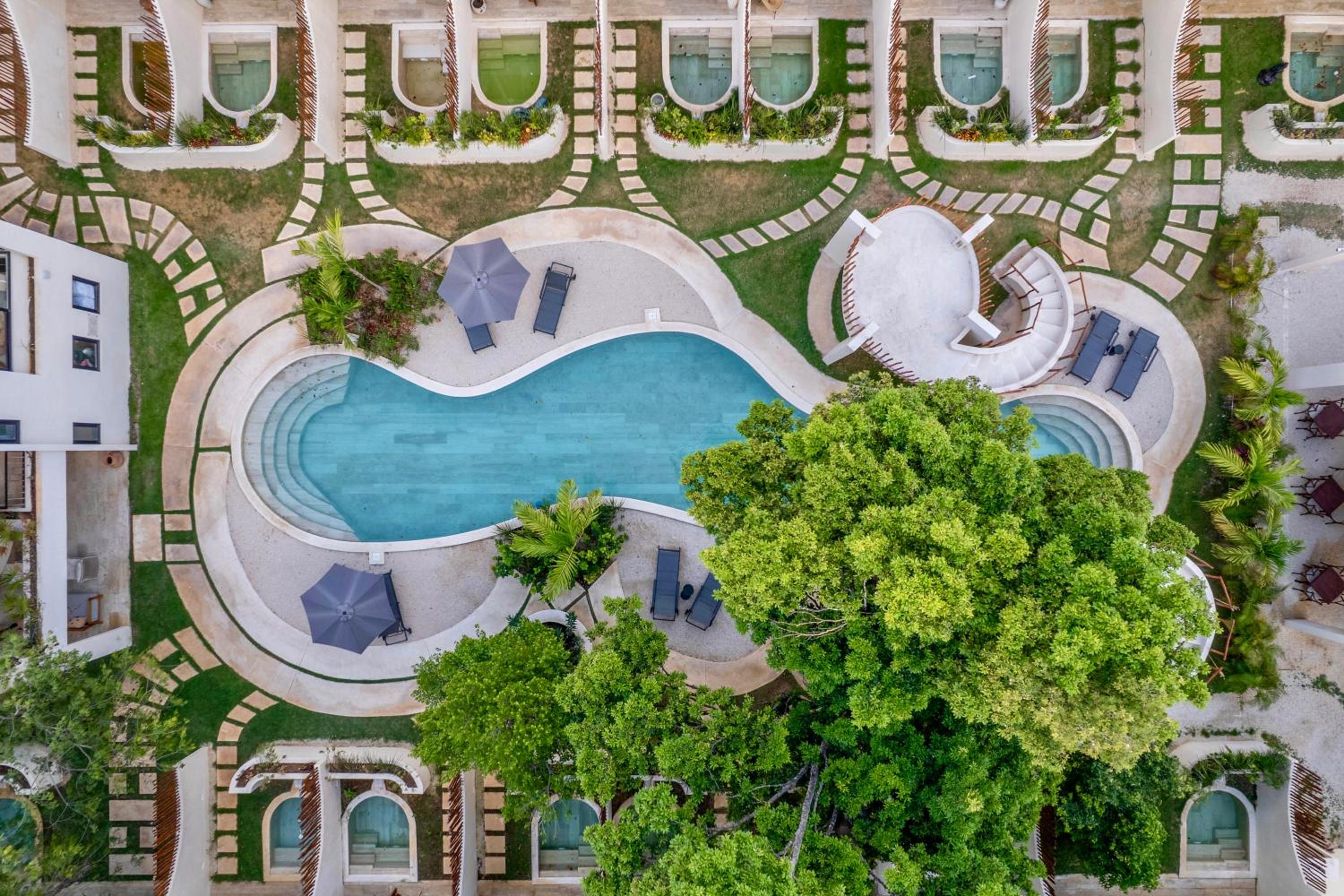
Loch Collection Tulum: minimalism and raw materials facing the reef
In Tulum, the architectural question is particularly sensitive. The destination was long defined by an aesthetic of straw and driftwood that eventually caricatured itself. The Loch Collection Tulum takes a different approach: that of minimalism, geometric rigor, and assumed materiality.
The outdoor pool, garden, and terrace constitute the three compositional elements of the site. Their articulation follows a logic of spatial sequence: you do not pass directly from the bedroom to the water. You cross thresholds, shadows, transitions that make arrival at the pool's edge more deliberate, more sensitive.
Studios that reject improvisation
The Studio King-Size Bed Deluxe, at 90 m², illustrates a strong architectural choice: refuse unnecessary partitioning. The unique, open space, treated in raw materials, makes natural light the only necessary ornament. The whiteness of the stucco absorbs the brightness of the Caribbean sun to redistribute it gently throughout the day.
The Deluxe Apartment, also 90 m², offers a more residential layout, with a clear distinction between the living area and sleeping quarters that gives the stay a domestic quality rarely found in hospitality in this region. It features the same economy of gesture, the same confidence in materiality rather than in the accumulation of decorative details.
La Suite Selection: Loch Collection Tulum
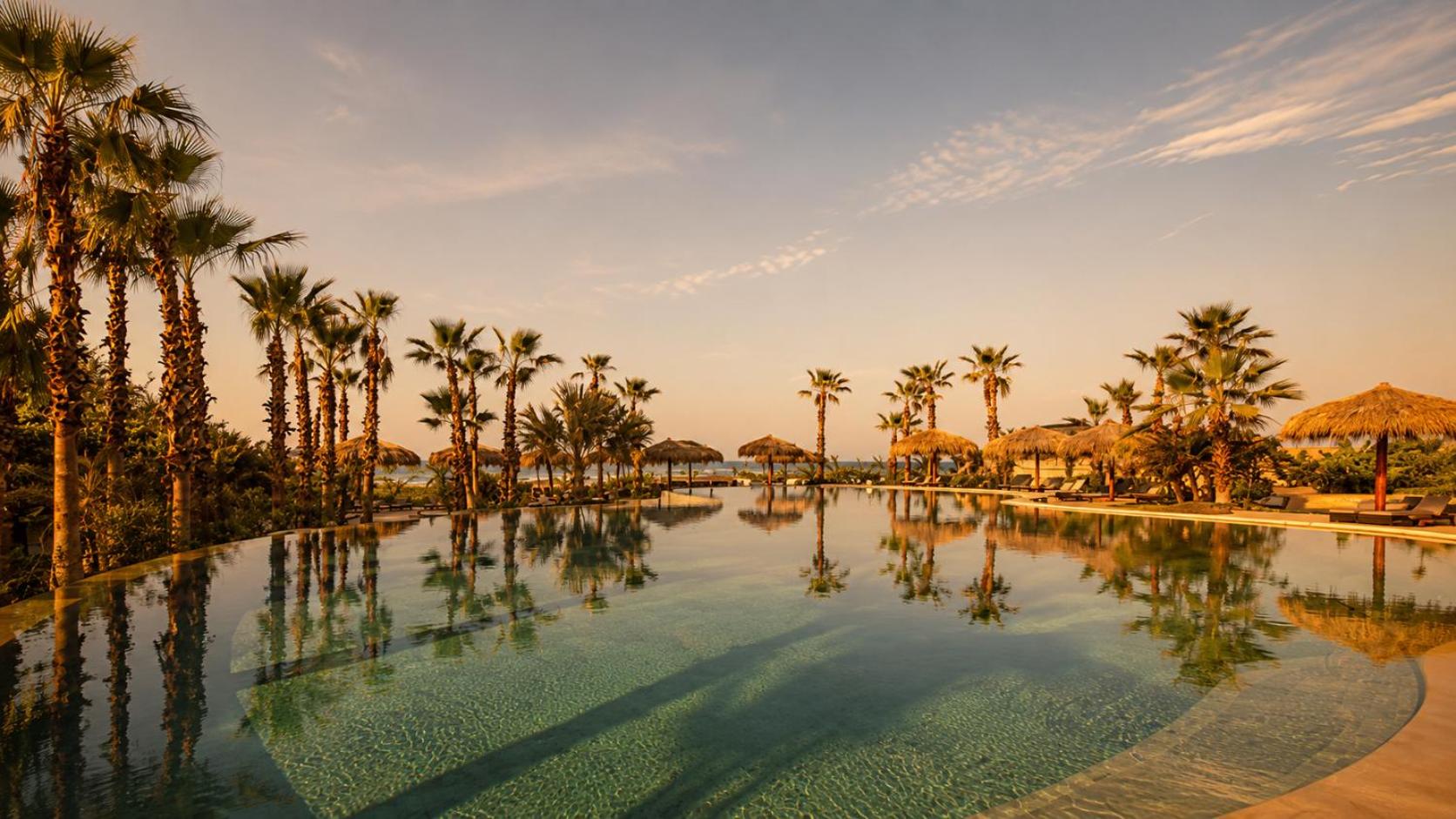
Kymaia Hotel Puerto Escondido: the suite as sculptural setting
In Santa María Colotepec, thirty kilometers from Puerto Escondido on the coast of the Mexican Pacific, Kymaia Hotel Puerto Escondido occupies a position of withdrawal that is in fact a statement of intent. Isolation is not a disadvantage: it is the very condition of the experience.
The hotel has a private beach, an outdoor pool and a hot tub, but these amenities are part of an architectural composition that renders them inseparable from the structure. Local stone, low volumes, and constant dialogue with sky and sea define a coherent formal language found at every scale, from facade to door handle.
Suites carved into the landscape
The Suite with Private Pool (74 m²) is the most autonomous unit at Kymaia. Its private pool, integrated into the terrace, creates a device of absolute privacy: one sees only sky, water and vegetation. The ocean horizon appears as backdrop, measured, never overwhelming.
The Deluxe Suite with Ocean View, at 51 m², embraces the verticality of the vantage point. From the balcony, the view imposes itself in all its amplitude: the Pacific, the reef, the jagged coastline. The suite itself is treated with an economy of means that underscores the unnecessary grandeur of the outdoor space.
For those wishing to explore other architectural gems along the Pacific, Indian or Mediterranean shores, our selection of the most beautiful suites with private pools on the Côte d'Azur offers an instructive Mediterranean counterpoint on how other latitudes address the same equation.
La Suite Selection: Kymaia Hotel Puerto Escondido
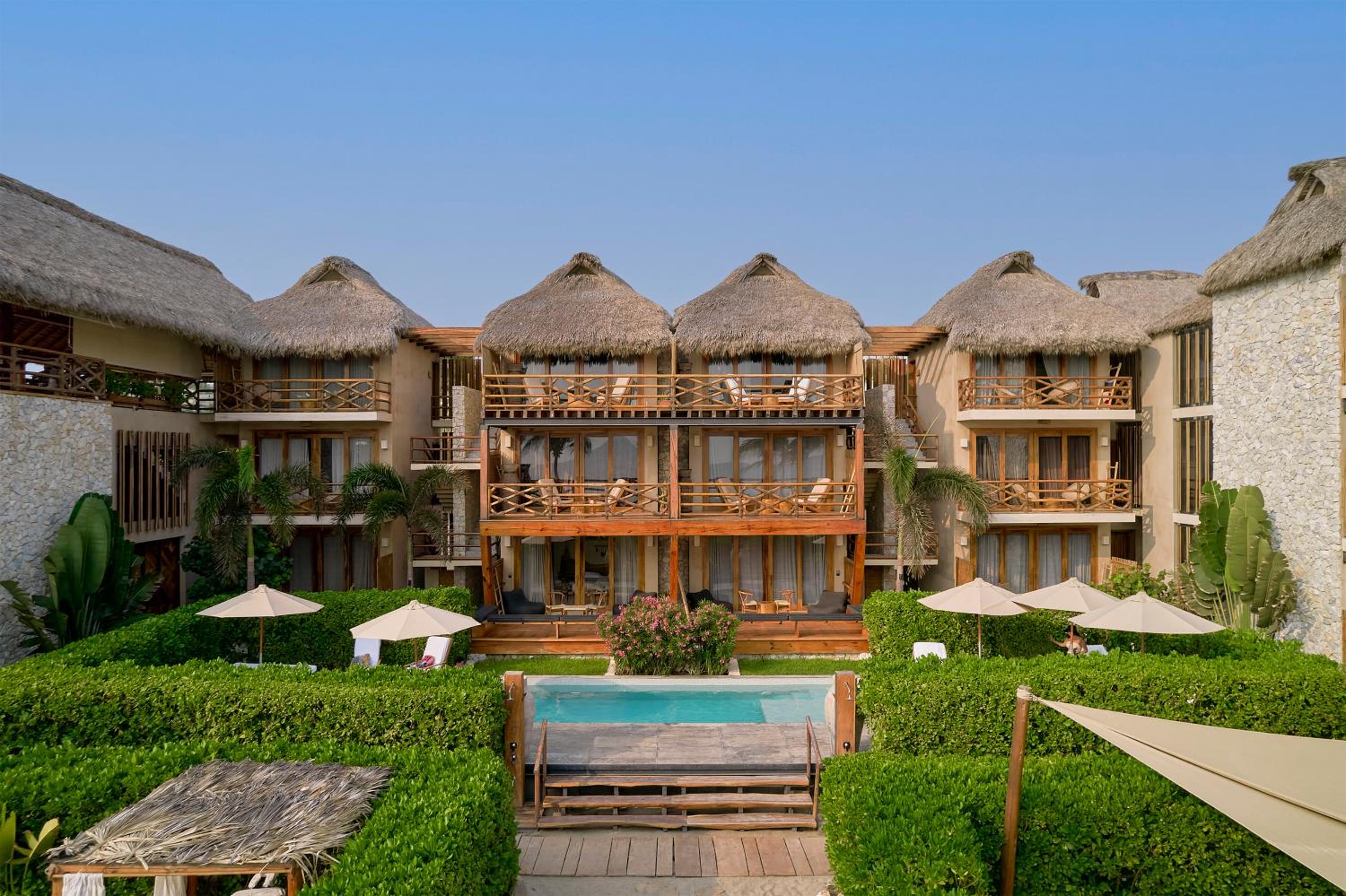
Puerto Escondido, between surf fervor and residential discretion: Casa Joseph Zicatela
At Brisas de Zicatela, just steps from the legendary Zicatela beach, Casa Joseph Zicatela offers a different interpretation of Mexican hotel architecture: that of a private home, reserved for adults, which rejects the standard hotel format.
The outdoor pool, garden and terrace are organized as in a characterful residence, with a quality of domestic scale that makes each space immediately appropriable. Some accommodations open directly onto the sea, with balconies that function as private vantage points over the Pacific.
Suites with residential architecture
The Beachfront Villa, at 250 m², is the showpiece of the establishment. Its size allows for a complete living arrangement, with equipped kitchen, reception space and dedicated terrace. It caters to those seeking the discretion of a private home with hotel services.
The Suite with Private Pool, at 100 m², offers another form of independence. Its private pool and sea view create a setting where time slows down, where the architecture of the setting serves as scenography for a very particular way of life (one that only this Mexican Pacific coast knows how to produce).
La Suite Selection: Casa Joseph Zicatela

ONTO Alvaro Obregon Mexico City: urbanism reinterpreted in the city center
The fourth figure in this Mexican architectural overview is urban and deliberately different. In Mexico, the ONTO Alvaro Obregon is located in Roma Norte, one of the capital's most architecturally coherent neighborhoods, less than two kilometers from the Angel of Independence.
Here, the landscape is not jungle or ocean: it is the city itself. The ONTO's architecture responds to this context with a restraint that distances the decor to highlight the surrounding urban texture. Terrace, restaurant and bar are articulated here as in a prestigious apartment where every detail has been carefully designed.
The establishment illustrates a strong trend in contemporary Mexican hospitality: the reinterpretation of the boutique-hotel model through a more demanding, more editorial architectural lens. A language found in other capitals that are reinventing their hotel typologies. Our guide to signature suites in Madrid explores this same dynamic in a European context.
Studios designed for the temporary resident
The Studio with Terrace (74 m²) is the most generous unit at the ONTO. Its terrace, in this urban density, constitutes a rare privilege: a private outdoor space that captures the light of the Bajío, that particular quality of sunlight on the Mexican plateau, slightly golden at the end of the day, very different from coastal light.
The Studio with Balcony, at 47 m², assumes economy of means as a design principle. The space is precise, without excess, and the balcony plays the role that the terrace plays in the larger open-air suites: that of a threshold between constructed intimacy and the outside world.
LaSuite Selection: ONTO Alvaro Obregon Mexico City
Key takeaways
Mexico stands out as one of the most innovative territories in world hotel architecture, with local materials (volcanic stone, raw concrete and tropical wood) elevated to signature status.
Siari Riviera Nayarit, a Ritz-Carlton Reserve and Kymaia Hotel Puerto Escondido represent two distinct approaches to the dialogue between architecture and Mexican natural landscape.
In Tulum, Loch Collection Tulum proposes a structural minimalism that contrasts with the destination's dominant vegetal aesthetic.
In Mexico City, ONTO Alvaro Obregon demonstrates that architectural radicality also expresses itself in dense urban contexts, far from the coasts.
Frequently Asked Questions
Which Mexican hotels offer the best contemporary architecture in their suites?
Siari Riviera Nayarit, a Ritz-Carlton Reserve in Riviera Nayarit, Loch Collection Tulum in Tulum and Kymaia Hotel Puerto Escondido on the Pacific coast are among the most architecturally coherent references. Each articulates a distinct formal language, grounded in local materials and openness to the landscape.
What materials characterize the architecture of luxury suites in Mexico?
Volcanic stone, polished concrete, tropical wood species and lime stucco constitute the principal palette of Mexico's most demanding hotel establishments. These materials are sourced from the local territory and form an immediately identifiable architectural vocabulary, far removed from the international marble of classical palaces.
What is the best suite with a private pool in Mexico for an exceptional stay?
The Beach Front Pool King Suite with Sofa Bed at Siari Riviera Nayarit (108 m²) and the Suite with Private Pool at Kymaia Hotel Puerto Escondido (74 m²) rank among the most accomplished options architecturally, with a pool integrated into the landscape composition rather than simply adjoined to the suite.
Does Tulum remain architecturally relevant for luxury hospitality?
Tulum has long been dominated by a palapa and natural materials aesthetic that has gradually become standardized. Establishments such as Loch Collection Tulum now offer a more rigorous minimalist alternative, founded on geometry and raw materials rather than recreated natural décor.
Can one experience architectural luxury in Mexico City outside coastal areas?
Yes. ONTO Alvaro Obregon Mexico City, located in the Roma Norte neighbourhood, illustrates how contemporary design vocabulary can express itself in a dense urban context. Its studios, particularly the Studio with Terrace at 74 m², offer a spatial quality and light that is distinctly particular: that of the Mexican plateau, inaccessible on the coast.
More from the Journal

Dolomites: Five Exceptional Suites for Alpine Winter
Limestone, raking light and mineral silence: in winter, the Dolomites offer a setting of rare density, which a few addresses have known how to translate into singular architectural experiences. The Suite by La Suite selects five suites that make the cold season not a constraint, but a raw material.
BY Jules Peulet

Rio de Janeiro: Three Addresses, Three Definitions of Exceptional Stays
Between the historic prestige of Copacabana, the international excellence of a five-star hotel facing the Atlantic, and the confidentiality of a guesthouse perched in the heights, Rio de Janeiro offers three distinct geographies of luxury. LaSuite deciphers each address to guide your choice according to your traveler profile.
BY Jules Peulet

City Break: 7 Urban Luxury Suites for an Inclusive Escape
Demanding LGBTQ+ travelers are no longer simply seeking "safe" urban destinations; they expect flawless architectural experiences and impeccable hospitality at the heart of the world's major cities. For this selection, Lasuite.com partnered with Mygayhotels.com. By combining their rigorous selection of certified "Travel Proud" establishments with our expertise in Quiet Luxury design, we have discovered 7 urban sanctuaries (Paris, New York, London, Madrid, Amsterdam, Rio de Janeiro and Rome). Each of these suites blends stunning aesthetics, strategic location and the assurance of hospitality that celebrates diversity.
BY Jules PEULET